 iStock
For years, these were two separate worlds. On the one hand, the factory floor, with machines, robotic arms and a production process centred on speed and precision. On the other hand, intralogistics, which involves storage, transport and order picking.
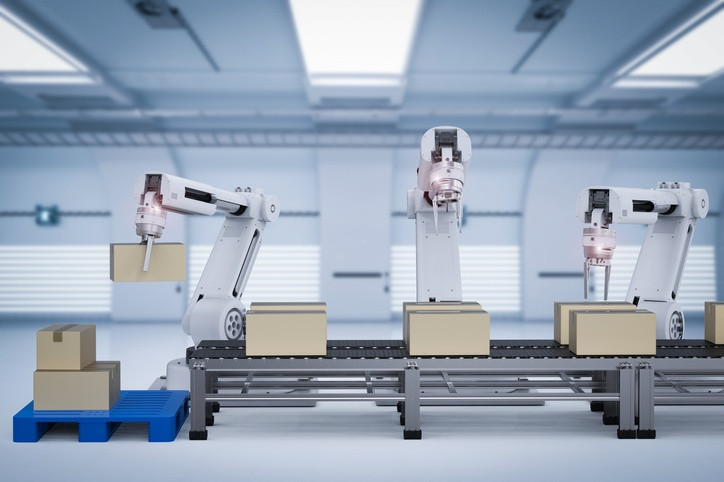
Anyone who watched a product being made on the production floor would only see it again much later during packaging, palletising and preparation for transport. That distinction is becoming blurred. Robots that remove products from the machine, pack them and place them on pallets now bridge the gap between production and logistics without the need for human intervention. For logistics managers and operations directors, this means that automation no longer stops at the final processing stage, but continues right through to the product leaving the premises.
Why these two worlds are now converging
The main driver is labour shortages. Manufacturing companies and logistics service providers are competing for the same tight labour market, and much repetitive work, such as lifting, stacking and moving goods, is proving difficult to staff on a long-term basis. In addition, the pressure to improve efficiency is mounting. Companies want to shorten lead times and control costs throughout the entire process, from raw materials to the finished product ready for dispatch, rather than just within the factory walls.
Technologically, a great deal has changed too. Cobots – robots that can work safely alongside people without the need for heavy-duty safety barriers – are easier to programme and more versatile than traditional industrial robots. Palletising robots – which automatically stack products into a stable, transport-ready load – have become more affordable and compact. This combination makes it feasible to integrate production and logistics handling into a single, integrated line, even for companies that do not have the scale of a large multinational.
Anyone who focuses solely on the production machine is missing out on opportunities in the subsequent handling stages. And the reverse is also true: an efficient warehouse is of little use if the production process still involves unpacking and stacking goods entirely by hand before they can enter the logistics chain.
JBS Tech connects production and logistics
JBS Tech, a machine manufacturer and engineering firm based in Weert, sees this shift reflected in its customers’ needs on a daily basis. The company designs, builds and maintains machines, systems and complete production lines – ranging from minor modifications to entirely new build projects – utilising robots and cobots for tasks including pick-and-place, welding, gluing, sanding, polishing, inspection and assembly. One of the services that literally bridges the gap between the two worlds is automated palletising, whereby a robot stacks products immediately after the final processing step and prepares them for storage or transport.
“Demand for stand-alone machines is declining, whilst requests for complete production lines are on the rise. From the start, with the raw materials, right through to the end, where the pallet is ready for dispatch,” says an engineer at JBS Tech. “As soon as you incorporate the logistics process into the design, you avoid having to intervene manually at a later stage.” This approach is in line with the company’s way of working, whereby it takes responsibility for the entire process as a single entity, from the initial idea and design through to implementation, management and maintenance.
Real-world examples underscore this. At a customer in the metal sector, a robot handles the feeding and removal of workpieces at a milling machine. In the food industry, JBS Tech has developed a semi-automatic filling station. The Helpende Hand cobot takes over tasks such as unloading a tube laser cutting machine, whilst the L-300 ProLine, a linear machine loader, automatically positions sheets before they move further down the line. Clients such as the Ministry of Defence, Wienerberger, Mademoiselle Desserts, Bakker Goedhart and Eijssen Dairy demonstrate that this approach is being applied across a wide range of industries, from plastics and metals to food – sectors in which packaging, palletising and preparing goods for transport often carry just as much weight as the production process itself.
Shorter processes, less manual work
Companies that design production and logistics handling as a single integrated process are seeing the lead time between the final processing stage and the product being ready for dispatch decrease. Manual handling, with its risk of errors and delays, is largely disappearing from that process. Staff who previously carried out manual lifting tasks can now be deployed to tasks that require greater skill or supervision. For companies operating in a tight labour market, this is not only a efficiency drive but also a way to make better use of existing staff. Those who embrace this integration thereby strengthen their own competitive position compared to companies that still treat production and logistics as separate processes.
Two worlds, one process
The trend identified by JBS Tech is not an isolated one. It touches on themes that are also central to the ICT&Logistiek and Logistica Next trade fairs, ranging from digitalisation and data-driven logistics to smart warehousing and zero-emission logistics. Whereas automation and robotisation used to be primarily a production issue, and smart warehousing a logistics issue, these topics are now converging. For logistics professionals whose remit covers both the production side and the intralogistics chain, this presents an opportunity to stop viewing these two worlds in isolation and instead regard them as part of the same process.
More information