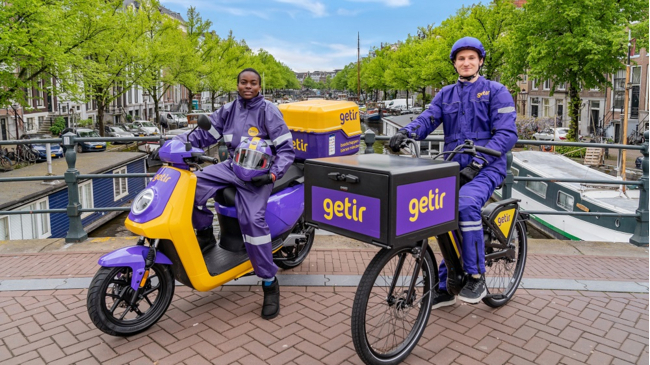
Both flash delivery companies with their dark stores and e-tailers with physical shops, have set their sights on physical proximity to consumers. This concludes consulting firm CBRE Netherlands after research on the development of logistics hubs in the Netherlands.
In one year, the number of dark stores has increased tenfold. Dark stores, in fact mini warehouses of flash delivery companies, have spread at lightning speed, from a few hubs in Amsterdam to almost 100 locations in 35 cities.

Despite the explosive growth and ever-increasing demand for online grocery-delivery services, the same survey shows that e-tailers see expansion opportunities by expanding with 'offline' shops. More than 40 online shops such as Ace & Tate, Coolblue and Fietsenwinkel[.nl] have already opened physical shops in the Netherlands. In ten years, 140 physical retail outlets have been opened by webshops of origin.
New phase
According to CBRE, these trends indicate that the development of online shopping has entered a new phase. On the one hand, flash delivery is responding to ever faster delivery. On the other hand, e-tailers see opportunities to broaden their service and offer a total brand experience by using physical shops.
Besides supply-side changes, there has also been development in consumer needs. Lockdowns have led to exponential growth in the number of online orders (and returns) over the past 2 years. In total, almost 20% of our retail spending was done online. This makes the Netherlands one of the leaders in the world. Although this share will decline slightly in the near future, from 2025 it will surpass the historically high level of 2021. In 2030, more than 30.4% of total retail spending takes place online.
Heightened expectations
In addition, consumers are becoming increasingly demanding towards parcel services. From flexible delivery times to same-day delivery and from low-cost to sustainable parcel delivery: this ever-increasing expectation pattern is leading to changes in the logistics network. The demand for logistics locations that are in the immediate vicinity of enough consumers will increase.
Implications for urban mobility flows
"When almost a third of Dutch retail spending is going to take place online, this has implications for mobility flows in the city. In order to keep our environment liveable, we need to think about structure and guidelines, while also making room for the logistics network in and around the city," said Jim Orsel, head of Industrial & Logistics at CBRE. "Specifically, this means three things. First of all, logistics space in large-scale housing plans in business parks should be a must. In addition, zoning plans for GDV/PDV sites should be generous to accommodate e-commerce and tomorrow's supply chain. Finally, in the city centre, the municipality should respond to adapted and future consumer spending patterns, identifying locations that can serve as last-mile hubs or dark stores and under what conditions this is then possible."