Implementing ICT solutions is quite complicated. TLN policy advisor Wout van den Heuvel can confirm that. During his presentation at ICT & Logistiek, he says that companies regularly call him to ask which TMS they should buy. And Van den Heuvel cannot answer that. "There is no blueprint for choosing an ICT solution, but we can give some tips."
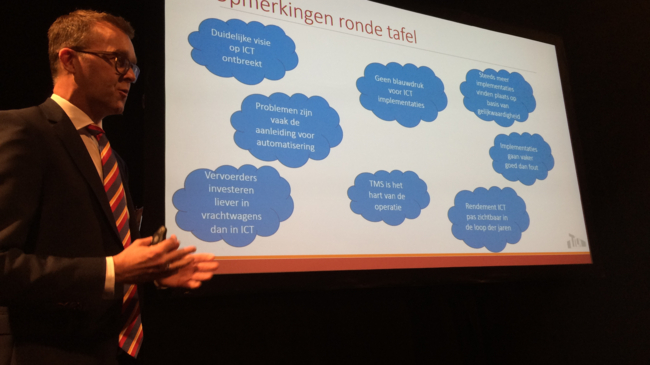
Earlier this year, TLN organised a round-table discussion with ICT suppliers to identify what companies need to bear in mind when choosing a supplier and software package. The trade association subsequently produced a list of dos and don’ts, divided into four phases. Van den Heuvel explained these dos and don’ts during the ICT & Logistics trade fair.
Phase 1: Preparation
- Make sure you have a clear vision. Know why you want to implement an ICT solution.
- Compile a top 5 of requirements that a package really has to meet.
- Only choose customisation if you are truly distinctive. Van den Heuvel: "Many companies consider themselves unique and think that customisation is therefore a better fit. But even if the product offered is unique, business processes are often the same. Then customisation is unnecessarily expensive. You can sometimes better adapt your business processes to the standard package, than the package to your business operations."
- Treat your supplier as a partner. "Implementing ICT never ends. Cooperation with suppliers is therefore long-term. Try to deal with each other as partners."
- Budget ICT as a percentage of turnover. According to Van den Heuvel, ICT is now often added on. The new system is not budgeted for and no people are freed up for it, even though this is necessary with such a drastic change.
Phase 2: Selection phase
- Involve the end user from the very beginning in choosing a supplier and a package. He knows what he needs and is going to work with the system. This also creates support within your organisation.
- Shortlist three suppliers and ask for a demonstration at their customers. If they cannot offer you that opportunity, you should ask yourself whether the supplier has a good relationship with its customers.
- Be open to the supplier, who obviously wants to sell you as much as possible. Are you looking for a total package or are you only interested in one component? Communicate this from the start.
- Manage expectations towards your own employees. Are you going for a total package? Then the company will be upside down in the coming period. It is important that employees know what to expect.
- Get external advice. The supplier naturally recommends its own product. An independent third party can tell you which package best suits your operations.
Phase 3: Implementation phase
- Implement the system step by step. "Don't go for a big bang," says van den Heuvel.
- Don't just do ICT on the side. Free up people to work on it.
- Take a project-based approach, using a steering committee, a project team and super users.
- Buy in missing knowledge and capacity.
Phase 4: Production phase
- Reserve budget for aftercare. You are only now starting to use the system. Most likely, you will find out that functionalities are missing.
- Implementation is never finished. ICT is so subject to change that you are always implementing. Therefore, keep working well with your supplier.
- Offer training and education.
- Secure knowledge and experience. Make sure knowledge does not stick to one person.
Editorial LogistiekProfs
Image: Comments that surfaced during the round table with ICT suppliers.