The ongoing labour shortage is forcing the logistics sector to think. Robotisation can partly solve the shortage, but it must be accompanied by social innovation. This emerged during Logistics Day 2020, the well-attended conference at football stadium Gelredome. "We cannot robotise everything. There are still so many tasks in which people are better."
"How many people work at a company with a human resources department?". Many participants at the Logistics Day 2020 raised their hand at this question from Mieke Damen. "A very annoying word," says the chair of the Image and Inflow Committee, an initiative of the Top Sector Logistics. "The term human resources sounds like people are means of production. Human capital already sounds better, but economic thinking still comes through in this term too."
Damen argues for a different view of people in logistics. Only then can we do something about the shortage of logistics talent. "We have 35,000 vacancies in our sector, with the level of education required getting higher and higher. From logistics courses, an average of 12,000 talents surge in every year. That is far too few," Damen concludes.
Social innovation
The Top Sector Logistics is trying to increase the intake with various recruitment campaigns. During Girlsday on 2 April, girls can now also learn about the logistics sector. But more is needed. Damen calls on all participants to go to schools and give guest lectures. By talking about the profession, young people can be enticed to choose a logistics course.
The next question is how to make the best use of that talent. Social innovation is necessary, argues Damen. "People are the key to innovation. Think of robotisation. How can we teach people to work with robots? If that succeeds, not only people but also robots will be used more effectively."
Mobile cobots
Robotisation is one of the answers to the labour shortage in logistics. Logistics service provider DSV is therefore investigating the possibilities of cobots. "We are currently building a new 95,000-square-metre distribution centre in Tholen. People are needed for that. By automating boring, repetitive operations, we can make the work more attractive for those people. Moving a pallet from A to B is really not a task that necessarily requires a human being," says Alex van der Plas, operations manager at DSV.
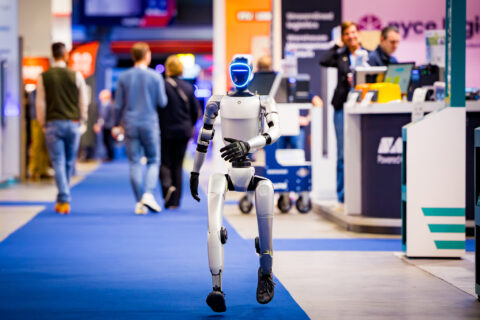
Together with Smart Robotics, DSV is working on an application with cobots on AGVs. Those mobile cobots must find their own way through the warehouse and pick items from the racks. "In doing so, we pay attention to interaction with people, among other things. We can by no means robotise everything. There are still so many tasks in which people are better. So it's important that those cobots can work together with people," explains Heico Sandee, co-founder of Smart Robotics.
"People are flexible"
As an example, Sandee mentions the order in which items are stacked on a pallet. The heaviest items should be at the bottom, the lightest on top. "People are flexible. If they have to stack a heavy item, they know how to move the other products on the roll cage in such a way that the heavy item still comes at the bottom. A robot doesn't understand that. With a robot, we have to feed items in a fixed order, the heaviest first."
If cobots can work between and with humans, an investment will more easily pay for itself. "In e-commerce, the peaks are in the evening hours. Should we then buy enough cobots to cover 100 per cent of that peak capacity? We can also deploy cobots for the 30 per cent of peak capacity that is needed on an ongoing basis. We can then use humans for the other 70 per cent," Van der Plas argues.
Pressing reset button
Cobots tend to be slower than humans. When it comes to palletising items, a human can stack an average of 500 items per hour. A cobot does not get beyond 360 items per hour. "But a cobot can last for several shifts. If one cobot replaces two employees, an investment is usually already profitable," says Van der Plas.
And the employees themselves? How do they experience working with a cobot? "Positive," replies Van der Plas, citing the example of a process for which DSV used two employees until recently. The first picked items from a box, the second put those items on a belt. The work of that second employee is now done by a cobot. "That man is happy that he is no longer rostered for that work. At the same time, the other man sees his job becoming a lot more interesting. Because he has to operate that robot and press the reset button every now and then."