How does delivery with light electric freight vehicles (LEVVs) increase the efficiency, customer satisfaction and sustainability of the logistics operation? That question was at the centre of a pilot by Rotterdam University of Applied Sciences and logistics service provider Nedcargo.
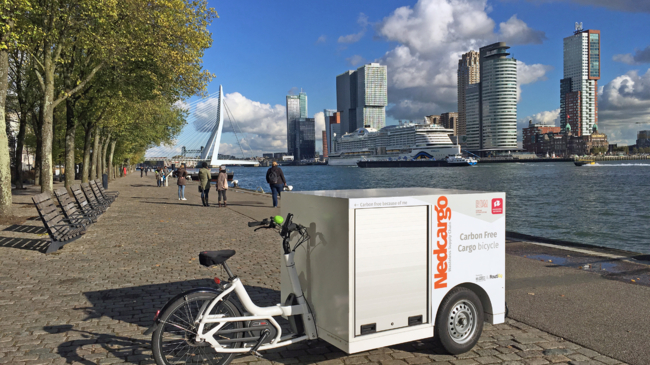
Logistics Management students delivered for Nedcargo as a student company 'HR Cargo' in Rotterdam city centre in recent months. Using an electric cargobike, they delivered drinks to 30 partners in the city centre.
During the pilot project - from September to November 2018 - 6,600 kilograms of drinks were delivered. This saved the students 350 truck kilometres and reduced CO2 emissions by 279 kilograms.
Innovative approach to city distribution
The project has provided both Nedcargo and the Logistics Management course with useful insights, the parties say in a press statement, and both parties say they intend to continue the cooperation. Jurgen Mook, COO Nedcargo: "The HR Cargo project helps us to look beyond what we are used to and, with the help of students, to work on solutions we have not yet thought of. In this way, we discover a lot about innovating urban distribution in a short time."
Closer to practice
In a project like HR Cargo, students are much closer to the real world. In fact, they are actually the practice," says Ewoud Moolenburgh, lecturer in Logistics Management at Rotterdam University of Applied Sciences. "Together with Nedcargo, we are working on a follow-up in the next academic year. The focus will then be on a longer duration of the project, in which several logistics parties can join, in order to generate more volume this way."
HR Cargo is a continuation of projects LEVV-LOGIC and Stadslogistiek. Besides Nedcargo and Hogeschool Rotterdam, Urban Arrow (cargobike), RoutiGo (planning system), GroenCollect (hub location), KennisDC Logistiek Zuid-Holland and Kenniscentrum Duurzame HavenStad of the University of Applied Sciences were partners in the project.