Logistics managers who want to train their staff are often tempted to do so in a classroom with a PowerPoint presentation. Chances are that employees have already forgotten the knowledge they have acquired when they walk out of the room. This can be done differently, argues Marjolein Berends of evofenedex. Berends tells during the Logistica trade fair how managers can train their staff 'high impact'.
Little time for training

Demand for training in the sector is increasing; especially in the field of safety, logistics managers are keen to train their staff, Berends notes. However, in logistics, where efficiency and cost control usually rule, there is little time to train people. Some companies deploy hundreds of flex workers during peak times, who need to be trained in no time. "In this sector, employees and team leaders are under tremendous pressure. So very long sessions that are of no use to them are best omitted. In the little time you have, you have to train as effectively as possible. You don't do that by dropping your staff off with a teacher."
So how do you train your staff effectively? According to Berends, originally an educationist, managers do well to let the employee actively participate in the process. "First of all, it is important for people to do something themselves. Let them see what can be improved in the company." evofenedex carries out many in-company projects, where it always asks employees to make improvement suggestions for the company. "In doing so, very good ideas emerge, which often also stick better because they come from employees themselves."
Training without theory lessons
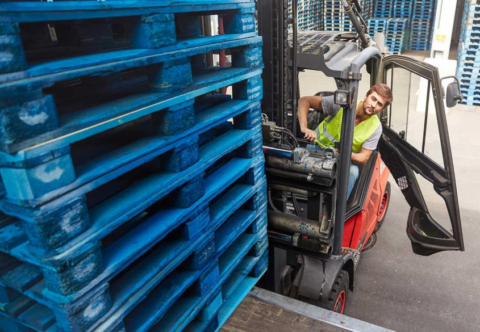
Berends further suggests having employees or trainees learn directly in practice. "We did a successful experiment with forklift training without a separate theory lesson. Trainees picked up theory based on the steps they do on a working day. For example, before they get on the forklift, they have to do a daily check. This is better taught next to a forklift than in a classroom."
Shock effect
Another tool for high-impact training is the shock effect. As an example, Berends again mentions the forklift training: "The instructor has a knack of just standing behind the forklift if a student does not look backwards often enough. You have to shock people and show them that they can immediately do something with the knowledge in their work."
Berends gives the workshop 'High impact training' at the Logistica trade fair, for logistics managers who want to get long-term effect from training. How do you create the shock effect? This workshop will literally and figuratively get you moving in the field of learning, knowledge and behavioural change. You can register for the workshop via this link.