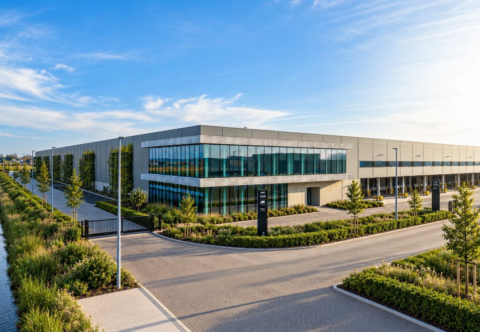
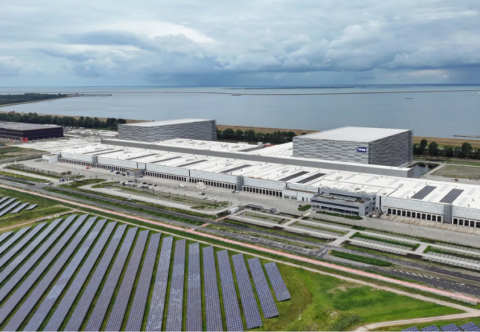
Demand for vertical solutions for logistics real estate in Europe is rising due to limited land availability and rising land prices. So says international real estate consultant CBRE in its report Up in the air: the case for vertical logistics solutions.
In the report, CBRE examines why vertical solutions are in demand and how this is affecting the logistics property market. The findings show that when land costs account for more than 50 per cent of total construction costs, vertical building becomes a viable solution. Logistics operations can thus not only save on land costs, but also parlay on their labour and transport costs by building in height rather than aiming for a larger footprint, or looking for a cheaper location further away from the market. Economies of scale in the industry and the growth of urban logistics are key factors here, further increasing pressure on available land.
High-rise warehouses versus multi-storey distribution centres
CBRE finds that two main forms of vertical building solutions are popular in Europe: high-rise warehouses and multi-storey distribution centres. With multi-storey buildings, there can additionally be a subdivision into internally and externally structured floors. Besides the availability of land, the uniformity of goods in the logistics operation largely determines the choice of one of these types.
According to Machiel Wolters, Head of Industrial & Logistics Research EMEA, we are not likely to venture into multi-storey distribution centres in the Netherlands. "In the Netherlands, we particularly signal a need for high-rise warehouses and internal vertical solutions. We are therefore seeing these increasingly common in new developments. One example is Primark's new distribution centre in Roosendaal, which will be 20 metres high and will have a floating intermediate floor so that work can be carried out undisturbed on the various floors. However, few true multi-storey distribution centres will be built in the Netherlands. Due to the spread of the urban and logistics landscape in the Netherlands, the price pressure is not high enough for that."
Adapting to technology
The real estate consultant further concludes that warehouses will increasingly be adapted to new technologies. Order picking accounts for a large part of companies' operational costs. By implementing automated systems, these costs can be drastically reduced and handling can be faster and more efficient. Warehouses will be adapted to this and vertical solutions will be used more often.
Editorial LogistiekProfs