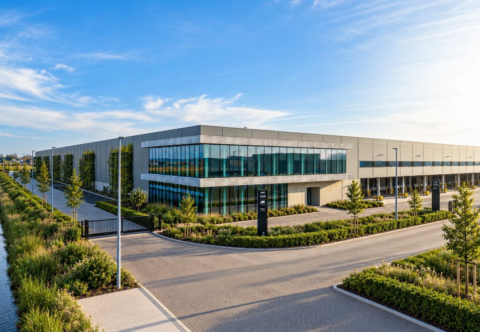
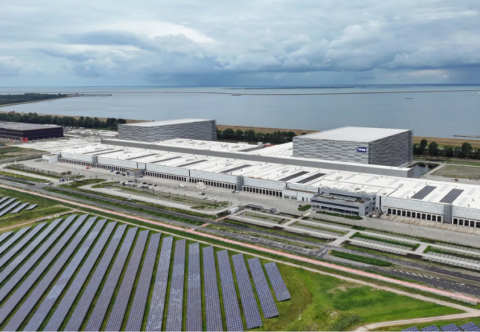
There is plenty of construction going on in logistics Netherlands. Ninety new distribution centres were completed in 2018, together accounting for an area of more than 2 million square metres. Bouwgroep VDR warns against cannabalisation of the country and advocates more circular construction: "These centres are constructed as if they will always be needed. Which they are not."
At the end of 2018, there was 33,343,000 square metres of logistics real estate in the Netherlands, spread over 2,000 buildings, writes the Financieel Dagblad. VDR builds around ten per cent of the distribution space that comes into use every year. The construction company expects that these centres will not be needed in the future and warns of an "industrial landscape full of discarded warehouses".
"These centres are being built at a rapid pace," director Luc Baltus told the FD, "and they are constructed as if they will always be needed. Which they won't. Our children will invent something smarter than these big centres, I'm convinced. And then they just stand there."
Old buildings
Old centres from the 1960s, 1970s or 1980s already no longer meet the requirements, Baltus believes. "Forklifts cannot move optimally there. They are not high enough. The floor is not strong or flat enough. Or they consume too much energy."
Vacant warehouses are now rare. The demand for logistics property is so high that tenants can be found even for older buildings. The total area of old vacant buildings is only 124,000 square metres.
Demolition is costly and polluting
Should those distribution centres become unusable in the future anyway, demolition seems to be the only solution. For instance, a 20-year-old distribution centre of VDR, which was leased by CEVA Logistics, is being demolished to provide space for new premises for parcel service GLS. However, that demolition is costly and polluting. Because, where does the residual material go? Baltus: "We don't know what you can do with some building materials at the end of their useful life. The question is whether you can still recover it as a pure product. In that case, incineration is often the only option."
Concrete foundations are also difficult to remove. Under a 50,000-square-metre warehouse in Bleiswijk, there is an old foundation of 8,000 cubic metres. "If we can no longer reuse the soil then we are slowly but surely cannibalising our country," he said.
Circular building
Baltus wants the future to be built with material that can be reused after demolition, without losing its value. In the director's ideal building, the floor is not concrete but geopolymer (which releases fewer emissions). The steel frame is not welded together, but screwed. Insulation, partitions and roofing can also be easily reused.
VDR hopes for more support for this construction philosophy. "The outside world has to believe in it. Like financiers. And municipalities can also help. They could require the owner to remove the building if it is not rented out for a few years. So that a clean plot remains."