Why wait until a component actually breaks down when, thanks to data and smart analytics, you can predict the need for maintenance much earlier? That question was central to ProSeLoNext, a four-year research programme in which three Dutch universities and seven companies from the SLF network jointly investigated how service logistics can become more proactive.
ProSeLoNext (Proactive Service Logistics for capital goods – the Next steps) was not a stand-alone research project. It represented the next step in a line of research that had originated within the SLF several years earlier. First came SLF Research (SLF-R), which was jointly funded by universities and companies. When that funding arrangement came to an end, new funding was secured through TKI Dinalog and the ProSeLo research programme was established. Four years later, this was followed by ProSeLoNext.
A step further
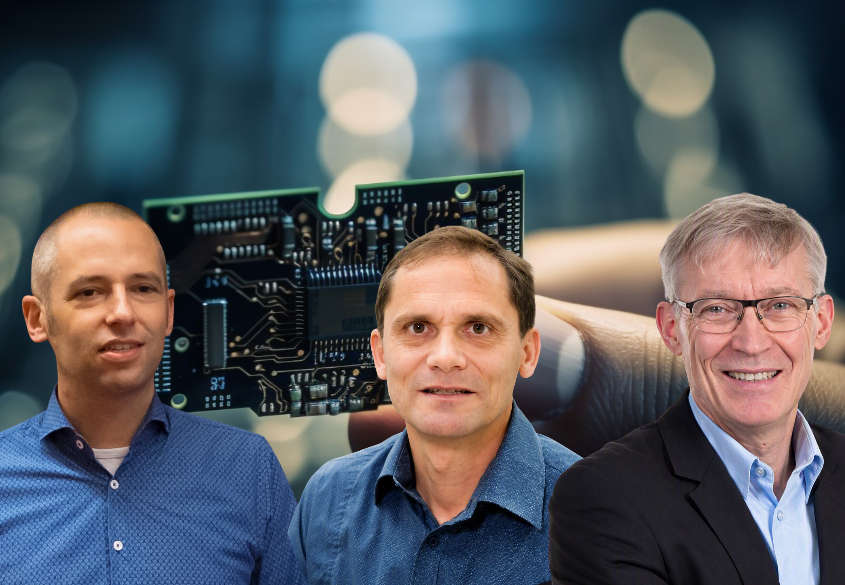
According to project leader Rob Basten (Eindhoven University of Technology), ProSeLoNext represented a clear step forward. “In ProSeLo, the emphasis was mainly on spare parts management. In ProSeLoNext, we went a step further. Thanks to sensors and data, it became possible to predict maintenance, manage service logistics more intelligently and explore new business models.”
Predictive maintenance
Basten and his research group focused on predictive maintenance: maintenance based on the condition of machinery rather than fixed maintenance intervals. Together with Canon Production Printing, they worked on a Maintenance Scheduler that automatically flags when maintenance is required. “Canon had already drawn up its own roadmap for predictive maintenance,” he explains. “Our researchers and students slotted in seamlessly with that. Ultimately, this led to a maintenance tool that actually issues alerts when condition-based maintenance is required. It has genuinely been implemented in practice.”
Managing stock more intelligently
Researchers at the University of Twente focused specifically on the logistics side of the story. After all, as soon as it can be predicted that a breakdown is imminent somewhere, a new question arises: how do you ensure that spare parts, technicians and tools are in the right place at the right time? Matthieu van der Heijden (University of Twente): “We investigated how real-time information can be used to manage stock more intelligently. Suppose one warehouse is about to run out of a particular part, whilst another warehouse still has two in stock. In that case, it’s better to move that part over in advance, before a shortage arises.”
At ASML, that principle was actually put into practice. Not the full scientific method, but the underlying principles, explains Van der Heijden. “A graduate student developed a practical system that enables ASML to proactively move parts between warehouses. This is now standard practice.”
A fundamental issue
Rommert Dekker (Erasmus University Rotterdam) also looked at decision-making in service logistics. His research focused, amongst other things, on stock management, contracts and the availability of spare parts for products that have long since ceased to be manufactured. “With capital goods such as aeroplanes or ships, we’re talking about lifespans of thirty years or more,” he says. “The production of spare parts often ceases much earlier. This raises the question: how do you ensure that those spare parts remain available? That is a fundamental service logistics issue.”

A simple intervention
Sometimes the solutions turn out to be surprisingly simple. At IBM, researchers developed a model for reducing stock levels when service contracts expire. “Our mathematical models were quite complicated,” says Dekker with a laugh. “But in the end, the practical solution turned out to be very simple. As soon as a customer indicates they won’t be renewing a contract, you immediately stop replenishing the spare parts stock. That idea generated immediate financial returns. Sometimes the greatest profit lies in a relatively simple intervention.”
Tangible results
It was precisely this practical nature that set ProSeLoNext apart from much traditional scientific research. Alongside PhD students, dozens of Master’s students and PDEng candidates also worked directly with the participating companies on specific practical issues. “Over thirty young researchers worked on this project,” says Basten. “This resulted not only in academic publications, but also in a great many concrete short-term outcomes that companies could put to immediate use.”
Strengthening each other
Many of those students even went on to join the very companies where they had carried out their research. As a result, the knowledge gained was not confined to universities, but also found its way into practice. “You can see that research and practice constantly reinforce each other,” says Basten. “We learn from the challenges faced by businesses, and businesses in turn benefit from new insights gained through research.”
Mutual trust
“The SLF was also an official partner in this project, and all the companies taking part were from the SLF network. They knew each other, which created a basis of trust. They also knew what to expect from scientific research,” says Basten. That mutual trust proved to be essential. Companies were willing to make their real-world data available, and researchers gained access to genuine operational challenges. “Companies don’t have time to wait years for results,” says Basten. “But within the SLF, they also understand that fundamental research takes time. As mentioned earlier, on the other hand, many concrete results emerge along the way through student projects.”
See what others are doing
Dekker sees yet another advantage. “Within the SLF, companies see what others are doing. If ASML or IBM are working on something, other companies naturally start to consider whether that might also be of interest to them. That’s how new ideas spread much more quickly.” It is precisely because companies are not direct competitors that there is scope to exchange experiences. “You need an environment like the SLF where people feel confident enough to speak openly about the challenges they face,” says Dekker. “That trust is incredibly important. Ultimately, that is what a network like the SLF is all about.”
A long-term endeavour
The researchers emphasise that the value of ProSeLoNext lies not only in the individual results, but above all in the long-term approach that has now been in place through SLF for over twenty years. New projects build on previous insights, researchers and students move on to work in companies, and practical experience in turn leads to new research questions. “Research has the greatest impact when you’re not working on it for five years, but for twenty,” says Dekker.
Basten agrees. “It is difficult to pinpoint exactly which innovations have been created solely by ProSeLoNext. But if you look at developments at companies such as ASML, Canon, Fokker, IBM and Vanderlande, you can see that, together, they are constantly taking a step forward. This is down to the long-term collaboration between companies, universities and students.”
Text: Pieter Pulleman
Curious to find out how data and smart predictions can improve your service logistics? Discover the possibilities at ICT&Logistiek and Logistica Next, from 3 to 5 November at Jaarbeurs Utrecht. Register for free.