Economies of scale, decentralisation and sustainability take centre stage at the Logistica trade fair's Logistics Real Estate Square. The popularity of e-commerce is increasing the need for large, central sustainable distribution centres with small consolidation centres on the outskirts of cities. This trend also has all kinds of implications for the design and construction of these logistics centres.
Walther Ploos van Amstel says same-day delivery is becoming the new norm in e-commerce. "After all, that is what people already get even now when they go to the shop. Customers are ordering in smaller quantities more often. This all leads to ever smaller cars going into the city to deliver stuff with a higher frequency and a lower load factor. This creates insecurity, congestion, noise pollution and air pollution."
Distribution centres on the outskirts of cities
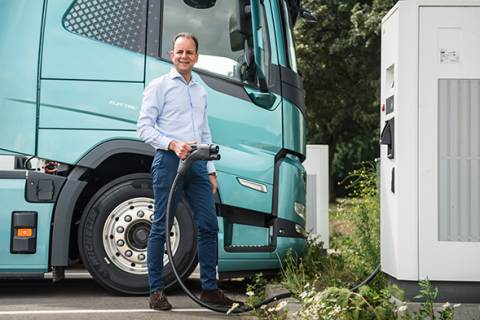
Ploos van Amstel does, however, have a solution in mind for this. By building consolidation centres (small distribution centres) on the outskirts of cities and then using small electric vehicles to deliver to city centres and residential areas, a large proportion of the disruption and emissions can be reduced.
The company Goodman also acknowledges that the average city is at its maximum in terms of transport pressure. "In London, all kinds of 'darkstores' are springing up on the outskirts of the city, where consumers' groceries are collected and loaded into vans. If online grocery shopping takes off here too, the demand for depots on the outskirts of cities will increase even further," says Tia van Beek, Goodman's country manager in the Netherlands.
A different layout to traditional warehouses
Consolidation centres or city depots will look different from traditional warehouses. For example, there will be less storage space and more space for cross-docking. “Tesco’s dark stores in London have only a few large overhead doors for food deliveries, and a multitude of small overhead doors for the vehicles heading into the city,” explains Van Beek.
Goodman is also currently looking closely at interesting locations on the outskirts of cities. "In Utrecht, Lage Weide is an excellent site for getting into the city centre quickly, and in that way, there is an interesting location for every major city in the Netherlands."
Large, centralised distribution centres are also in demand
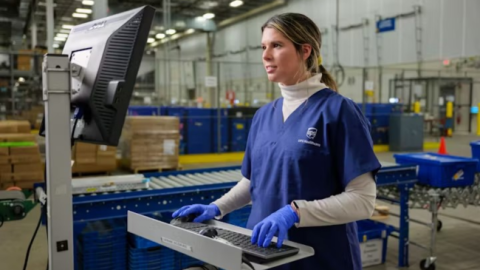
Alongside small consolidation centres, there is still room for large, centralised distribution centres. This is mainly due to developments in road transport, with Europe, for example, investing heavily in creating robust, international transport links. “It is becoming important for companies to consolidate their central stocks in large warehouses located a stone’s throw from the trans-European networks,” says Ploos van Amstel. “Developments in mechanisation and robotisation are driving the trend towards economies of scale. Goods are no longer dispatched in batches of pallets, but in individual boxes. The number of operations required to prepare orders is increasing exponentially, making mechanisation and robotisation inevitable.”
This trend towards economies of scale is again evident among e-commerce companies. In recent years, Goodman has developed distribution centres for Zalando, Amazon and Home24, among others. Dimensions of more than a hundred thousand square metres are not uncommon.
A different type of building
This sector clearly calls for a different type of property, according to Goodman and Heembouw. “Think of multiple mezzanine floors for the storage of small goods. That, in turn, places different demands on the positioning of columns and on the point load that the floor must be able to bear. And don’t forget the compartmentalisation. Normally, distribution centres are divided into compartments of 10,000 square metres for fire safety reasons, but with the additional floor space resulting from the mezzanine floors, the compartments become relatively smaller,” says Rinus Verhey, commercial director for industrial premises at Heembouw, which specialises in the turnkey construction of distribution centres.
Operating costs factored into rent
The trend towards economies of scale also means that a large proportion of current warehouses will soon be unsuitable for meeting demand from the business sector. “They are too small, too far from the city and too far removed from the trans-European transport network. Take a look at the construction wholesalers, for example, which collectively have 4,500 stock points. That’s more than the number of supermarkets in the Netherlands. That’s unsustainable, and something similar applies to, for example, catering wholesalers.”
Another factor is the relatively high operating costs of existing DCs compared to new premises, which are becoming increasingly sustainable. A DC certified BREAAM Very Good, the middle sustainability class, is already not so special anymore. Verhey: "The costs for water, gas and electricity in a DC from the highest sustainability class are up to 3 euros per square metre lower than in existing buildings. Those who then choose an existing building because of the low rent might be disappointed because of the higher operating costs. In time, I therefore expect landlords to include operating costs in the rent, so that a good comparison becomes possible."
Editorial LogistiekProfs