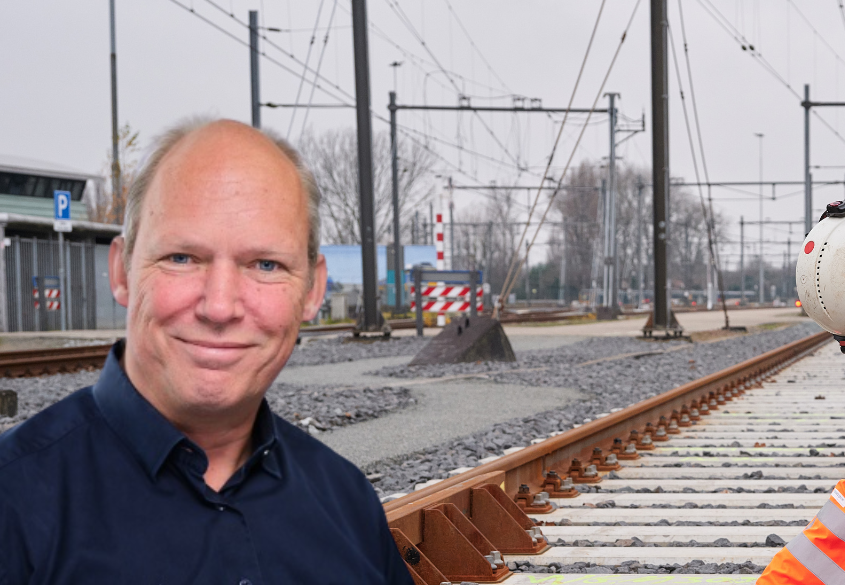
According to Wouter Lampe, anyone who still views return logistics as simply the disposal of used parts is missing the development that service logistics is currently undergoing. At voestalpine Track Solutions Netherlands, returns logistics is emerging as a strategic tool for keeping materials available for longer, minimising delivery risks and making the transition to a circular economy. “We are moving from linear supply chains to closed-loop systems. Return logistics is one of the keys to this.”
This calls for a different way of thinking. The focus is not on delivering products, but on guaranteeing availability. “We are shifting from supplying parts and components to ensuring availability,” says Lampe, Director of Strategic Development. “Faults must be resolved quickly, whilst new parts may not be available for months or sometimes even years.” It is precisely for this reason that he sees reverse logistics as a way of making hidden value available again.
Fourfold benefit
According to Lampe, a well-organised returns flow delivers benefits in four ways. Firstly, it prevents usable materials from remaining unused in warehouses. In maintenance and new-build projects within the rail infrastructure, spare parts are almost always left over. These often end up in local stock and subsequently fall by the wayside. “That’s actually dormant value; money tucked away in an old sock. As soon as you retrieve those materials, you can put them to use again.”
Furthermore, return logistics enables refurbishment and reuse, allowing systems to remain operational for much longer. At the same time, the supply chain becomes more resilient, as organisations become less dependent on foreign suppliers and increasingly scarce components. Finally, reverse logistics contributes directly to circularity. Materials remain in circulation for longer and recovered raw materials can be reused. “That is not only sustainable, but ultimately also economically attractive.”
From linear to circular
Remarkably, according to Lampe, this circular approach is by no means new. “In the past, labour was cheap and materials were expensive. Virtually everything was repaired and reused. Then that changed and we switched to a linear economy.” Now the balance is shifting once again. Raw materials are becoming scarcer, sustainability is gaining in importance, and modern technologies are making refurbishment attractive once more. “In fact, we are returning to a circular economy, but this time it is much better organised and supported by data.”
From theory to practice
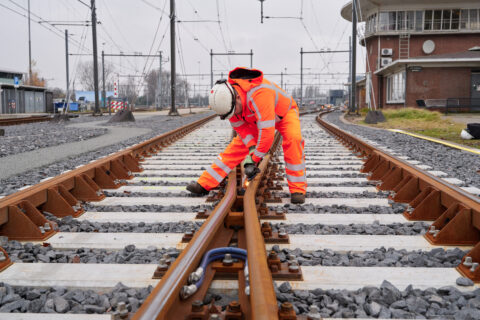
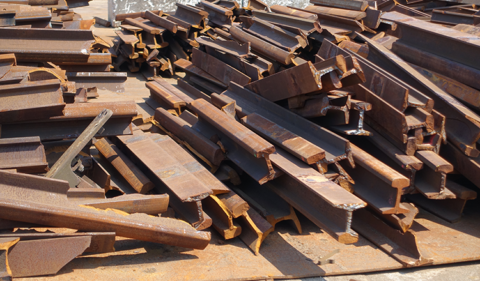
Lampe cites the reconditioning of relays for railway signalling systems as an example. Since 2002, around 200,000 relays have been recalled, reconditioned and put back into service. New units now only need to be purchased on a very limited basis. “What’s remarkable is that the reliability of a reconditioned relay can actually be higher than that of a new one.” Not all components are yet suitable for reconditioning or recycling. Lampe cites railway tracks as an example. When used railway tracks can be returned directly to the steel producer after dismantling to be remelted, this creates a virtually closed material cycle with significantly lower CO₂ emissions. “Technically, this is already possible, but the logistics chain still needs to be adapted to accommodate it.”
System transition
According to Lampe, the returns logistics of the future is not about the next round of optimisation, but about a fundamental systemic change. Asset management, maintenance and logistics are increasingly converging and are supported by data. Depending on their condition, components are reused, reconditioned, used as donor parts or processed into new raw materials. A good digital asset management system is crucial in this regard. “You need to know exactly which components you have, where they come from, how old they are and what options are still available.”
Artificial intelligence will also play an increasingly important role in this. AI can help to better predict maintenance needs, determine stock levels more intelligently and organise returns flows more efficiently.
Inspiration
The developments at voestalpine Track Solutions Netherlands are not an isolated phenomenon. Lampe has been involved with the Service Logistics Forum (SLF) for many years, which, in his own words, provides him with a great deal of inspiration. “We have our feet firmly on the ground in our day-to-day work. Within the SLF, you meet people who approach the same issues from an academic perspective or from a completely different sector. Sometimes you learn from others; sometimes you set the example yourself.” It is precisely this combination of academia and practice that he sees as the strength of the network. “It’s nice to be lifted above the day-to-day routine every now and then.”
From products to services
Lampe is certain that service logistics will undergo radical change over the next ten years. The focus will no longer be on owning products, but on ensuring the availability of complete systems. This calls for different business models and a different organisation of logistics chains. “We are moving from components to systems, from products to performance, from ownership to availability, and from linear chains to closed systems.”
In his view, service logistics deserves far more attention than is currently the case. “Many organisations still view service logistics as something as basic as water from the tap: it’s just there. As a result, the subject does not always receive the attention it deserves. Yet it is precisely here that major strides can be made in terms of availability, efficiency, resilience and sustainability.”
Return logistics is not merely the final piece of the jigsaw, but rather the foundation for a new way of thinking. “It is one of the most important keys to making service logistics future-proof.”