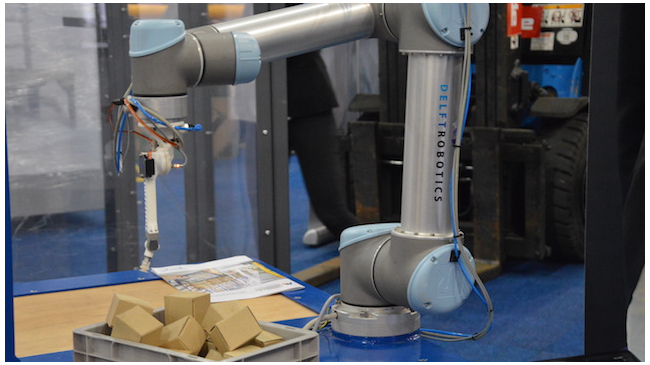
Robotics is advancing in logistics. A big challenge for robots remains picking goods. Many products and boxes vary in size, while robots - good at performing repetitive tasks - cannot handle that variation. Fizyr wants to change this with deep learning software.
Herbert ten Have, ceo at Fizyr, explains during Logistica how Fyzir teaches robots to deal with different products and formats. It does this through deep learning, a form of machine learning that uses neural networks to teach a computer complex tasks.Fyzir (formerly Delft Robotics) does not tell the computer what to look for, but gives the computer so many examples of a product that the algorithm itself discovers what it can recognise a product from. The algorithms learn this through pictures. It usually takes a few thousand pictures to do that. "Just like when you teach a child the difference between an apple and a pear. If you give a child an apple often enough, at some point they will automatically know it's an apple."
The big challenge is in products like meat, bouquets and vegetables; products that always differ in size. For this, the algorithm creates a 3D image of the product, which it uses via a point cloud to search for a flat surface to pick the product. The algorithm then navigates the robot to the product and activates the gripper. "All this happens in no time," Ten Have explains.

Ten Have expects Fizyr to play a big role in logistics. "Almost all situations where robots are currently used involve goods to person, for example at Amazon and Vanderlande, so there is still a lot of ground to gain." Even at AutoStore, a system that brings totes from a grid to order pickers, the goods are sent to the picker. "We integrate the robot there that can also pick goods from the box. Thus, AutoStore can automate the whole chain."