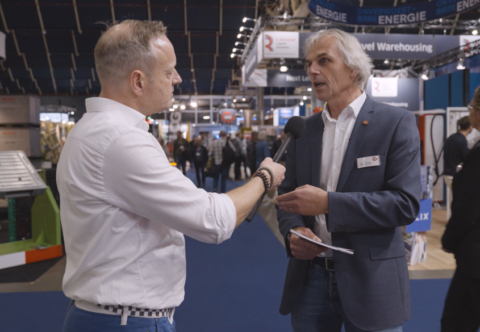
The technology and the willingness among the parties are there, now just the push. That is the point that unfolds during the Computable debate session during trade fair ICT & Logistica 2018 on (sharing) data and how data-driven technologies can help the logistics sector move forward. "Just start."
Well, nurtured by debate leader and Computable editor-in-chief Sander Hulsman, the three debaters Fouad Allabari (managing director HSO Analytics), Rob Schuurbiers (founder Simacan) and Nanne Schriek (Evofenedex) are willing to give that push. With in the background the buzz of the ICT & Logistics fair, the annual event where (ICT) solutions and logistics processes come together, the trio shines its light on data - also called the new gold - and the role it can play in logistics. Or rather, how to make the step from logistics to smart logistics?
Skinny six
First the bad news. Compared to numerous other sectors, the logistics sector is lagging behind in terms of digitalisation. That much is shown by Evofenedex's report 'Data and digitalisation in logistics' alone, which Schriek comes up with. It shows that around two in five trading and production houses (shippers) consider the current state of automation/digitisation of logistics processes to be at least good; for almost one in five, however, it is less than adequate. Even more figures: shippers give themselves a meagre six for the extent to which processes are automated/digitised and the extent to which real-time data is utilised.
Somehow incomprehensible, responds Schuurbiers, because if any sector can benefit from increasing digitalisation and embracing new technologies - we mention blockchain, but also machine learning and big data - surely it is the transport sector. "But the reality is that many parties have yet to put a crank on that. The technology is ready, now we just need to understand that we can learn from data."
Release data
Allabari also notes that the challenge no longer lies in the technology - which is ready - but in the acceptance rate. "So we also have to learn to share data. We have to accept that we can help each other with each other's data, from which we only generate more. My advice: release it, share it." For him, the benefit is obvious: "By sharing data, you increase your insight and enable yourself to better assess the impact of your decision across multiple business processes."
Sçhuurbiers does bring a nuance though: "Release data, but with policy," he says. To add that we need to move away from silo thinking, but that doesn't mean you have to release all your data to still make profits from data sharing. "Very simply, by sharing data about loads, you take the phone traffic about what time and when a load is coming out of your process. Then you keep more time for other work."
Schriek once again pulls out his report: 70 per cent of shipper companies still use Excel to tie different systems together.
Getting demand sharp
Asked about reasons for this delay, the gentlemen mentioned a variety of reasons. The gist: there is often an attitude among companies to first get their own organisation in order and, who knows, to look over the horizon later. However, Schriek suspects that while the willingness to digitise is there among companies, it is not clear to them what the next step should be. "What do I solve with digitisation or with blockchain? Getting that question sharp, that is still missing from many companies," Schriek said.
Alabari hits the essence if possible: "Perhaps unknown makes unloved. While there is a lot of talk about digitalisation within the sector, too little is happening. It's a bit like teenagers talking about sex: they often do, but they generally don't dare to do it. You need innovators, visionaries who dare to experiment, who can explain to their ceo that the returns from digitisation or embracing new technologies are not immediately clear or will only show themselves in a decade or so." Although, the example he mentions next should at least inspire those present. Allabari tells of a logistics employee in the US who tries to convince his employer to incorporate Uber-like principles into the business process, to which the boss only sees bears in the road. The employee decides to resign and set up his own company - called Convoy. Allabari: "In less than two years, Convoy was twice the size of the company where the employee was working."
Crucial word: together
And now, Hulsman wonders, after the gentlemen have exchanged views with the audience for almost an hour. Advice, tips? Schriek opens: "My tip is to just start small. Look at a current business problem and ask yourself how you can improve it with digital data sharing." Schuurbiers adds that companies need to feel the conviction that it is valuable. "Look at what data you have available and look at it together," says Allabari, which is the crucial word in this debate: together. "It's in the word together. Looking at data together with other parties who have different glasses on. What exactly is happening and why? We sometimes forget that."
This article appeared earlier on Computable.nl