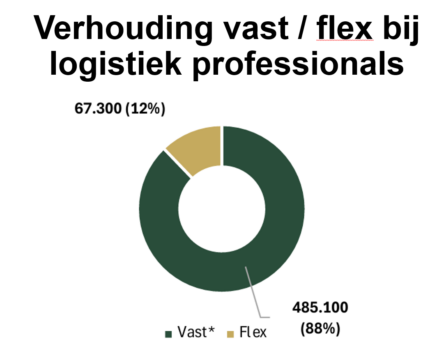
The proportion of self-employed workers and seconded professionals in the logistics, transport and manufacturing sector has risen from eight per cent in 2022 to twelve per cent today. The sector therefore remains below the market average of eighteen per cent. Nevertheless, this trend is striking, as in many other sectors the proportion of external professionals is actually falling. This is evident from the latest edition of the Talent Monitor, a joint publication by HR tech service provider HeadFirst and labour market data specialist Intelligence Group.
Demand for external professionals in logistics, transport and manufacturing is under pressure. Companies are outsourcing around 60 per cent fewer assignments than a few years ago. At the same time, the number of self-employed professionals and seconded staff in the sector continues to grow. This is creating a market in which more professionals are available, whilst demand from organisations is falling. Despite this trend, working independently and on a project basis remains attractive to professionals in the sector.
The number of responses per assignment also shows that the dynamics are changing. For a long time, the number of applications per assignment was one and a half to two times higher than in 2022. It has now returned to the level seen four years ago.
Rate growth is lagging behind the market
For external professionals who secure an assignment, rate growth continues to lag behind that of other sectors. The average hourly rate in logistics, transport and manufacturing is 98 euros per hour, compared with a market average of just over 102 euros. Over the past twelve months, rates rose by 1.2 per cent, which is less than inflation and represents the lowest growth of all the sectors surveyed.
Clear differences are evident between occupational groups within the sector. Managers in business and administrative services have the highest average hourly rate (€113.36), followed by business administration specialists and organisational consultants (€109.49) and information and communication technology managers (€109.26). Software developers, at €95.10, are closer to the sector average.
Organisations are more cautious
Sam van de Kreeke, sector director for smart industry (manufacturing, logistics and retail) at HeadFirst, recognises this pattern from real-world experience: “We are seeing that organisations have become more cautious about hiring external staff, but at the same time are taking a more selective approach to the expertise they require. The focus is shifting from capacity to results. It is precisely in areas such as automation, AI and supply chain optimisation that specialist knowledge remains in demand. This explains why the proportion of external professionals is growing, whilst the total number of assignments is falling. Talent with the right skills remains highly valuable, even in a changing market.”
The Talent Monitor is based on labour market data from Intelligence Group, combined with recruitment data from HeadFirst Group. The research is supplemented by the International Talent Acquisition Monitor (ITAM), a quarterly survey of an average of 4,000 Dutch people and 30,000 Europeans, plus data from Statistics Netherlands (CBS) and other labour market sources.’