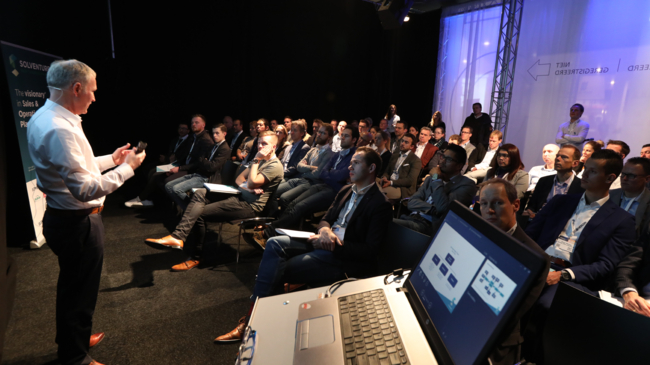
At Logistica, the warehouse takes centre stage, but its layout is increasingly determined by the rest of the supply chain. No wonder, then, that BLMC's Mini Supply Chain MBA drew full houses for three days. More and more companies are realising that the solutions to many problems can be found in the supply chain. Edward Heijnen on behalf of BLMC: "Companies think they know what the customer wants, but often that is nothing more than an assumption."
The world is on the move. For this, Edward Heijnen uses the term VUCA, which stands for volatility, uncertainty, complexity and ambiguity. In other words: the market is becoming more volatile, uncertain, complex and ambiguous. Companies will have to respond to this. How? Through more collaboration. "There are many definitions for supply chain management, but ultimately it's about collaboration. Cooperation within and outside companies," says Heijnen, who runs part of the Mini Supply Chain MBA on behalf of BLMC.
Cooperation should focus on increasing added value for the customer. "What does the customer want? If you don't offer him value, he's not going to pay. Many companies think they know what the customer wants, but often this is nothing more than an assumption. One of the companies I work for says it focuses on the relationship with the customer. That customer recently revamped its machinery, as a result of which the company's products suddenly turned out not to meet specifications. If the customer relationship had actually been a high priority, the company would have known that beforehand."
From awareness to unrest
Heijnen argues that the added value of companies often leaves something to be desired. This is also the case with the audience in the LogistiekProfs theatre. When he asks who works at a company where 25 per cent of the activities do not add value, many hands go up in the air. "Our experience is that on average 20 to 40 per cent of activities do not add value. The cause lies in silo thinking, the pigeonholing within companies. A shame, because those activities do cost money. Only when those costs are made visible does awareness grow."
Awareness is the first step. After that, agitation grows: companies are starting to realise they need to change. The next question is: how to do that? BLMC has developed a Supply Chain Optimisation Method consisting of nine steps that are all interrelated. ICT, for example, is not addressed until step 8. "We often hear that: that all problems are solved once the new ICT system is up and running. But it is important to think about the design of processes first. Otherwise, nothing will change."
Steer by output
BLMC notes that ten factors recur in every improvement project. The first factor concerns the people in the organisation. Different processes and different activities require different behaviour, but this is not always obvious. "Often you see that people doubt whether they can exhibit the requested behaviour. Whether they have the right competences. If there is doubt, changing behaviour is not going to work," Heijnen speaks from experience.
Another important factor is the output of processes. Is the desired quality and reliability being achieved? Or are deviations taking place? Heijnen advises companies to act mainly on this. "Suppose a department should realise an output of 100, but only achieves 80. Then it is important not to point the finger at the people in that department, but to take the output as the starting point for discussions. That prevents emotion from creeping in."
Integral approach
Especially in supply chain improvement processes, an integral approach is important. Many companies underperform due to sub-optimisation. "Suppose department B can save an hour if department A works five minutes longer. That leads to awkward conversations, because department A has its own targets and is often judged harshly on them. Still, that improvement has to be made. Always keep looking at the higher corporate interest."
This integral approach applies not only to the company, but to the entire chain. Heijnen: "I come from the food sector, where suppliers are confronted with fixed delivery times at retailers' distribution centres. But is it in the interests of the chain if a supplier has to send a separate lorry for that? Don't blindly say yes to customers. For instance, what do you do if your customer asks you to deliver not twice, but four times a week? Most suppliers immediately say yes, because after all, it is the customer who is asking. But have a cup of coffee first and look at other solutions together."
Not measuring for the sake of measuring
Finally, Heijnen touched on the importance of performance indicators. These are valuable, but are often misapplied. "Don't go measuring for the sake of measuring. It makes no sense to measure a certain performance if you cannot turn the knobs to improve it. In addition, make sure that performance indicators are aligned," says Heijnen, again pointing to the issue of sub-optimisation. This occurs precisely when different departments use different - conflicting - performance indicators. That blocks any kind of cooperation between departments.











