Shippers and logistics service providers should sharply reduce their CO2 emissions in the coming years. State Secretary Van Veldhoven of Infrastructure and Water Management is giving the Top Sector Logistics almost 50 million euros extra for this purpose. She also called on all participants at the Top Sector Logistics congress to contribute to reducing emissions. A good tool for this is Lean analytiX, a new method to map the CO2 footprint.
Aad Veenman, figurehead of the Top Sector Logistics, stressed it again: logistics must increase efficiency by a factor of six to meet the Paris climate targets. "CO2 emissions must not be a little lower, but very much lower. That is a joint task," Veenman spoke in his opening speech of the annual congress of the Top Sector Logistics.
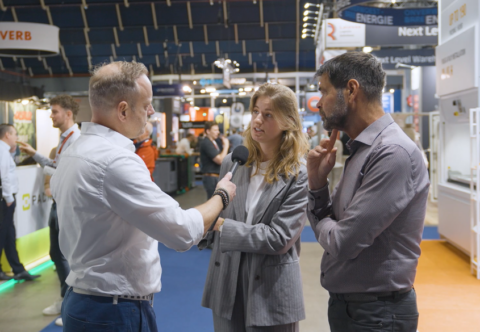
He was joined later in the day by State Secretary Van Veldhoven of Infrastructure and Water Management. "We have created the environmental problem bit by bit and we can only solve it bit by bit. Every little bit helps. You can all contribute," she spoke to the conference participants at the packed main grandstand at the PSV stadium.

Profit from sustainability
State Secretary to make funds available to encourage the transition. Earlier this year, the cabinet already made 300 million euros available for initiatives that contribute to the climate goals. "Of this, 25 million euros will go to logistics, simply because this sector came up with better ideas than other sectors. For the period until 2023, an additional 23 million euros will be added to reduce CO2 emissions and make the sector cleaner."
Van Veldhoven pointed to the results so far. "Ninety per cent of the 2020 targets have already been met. That offers room to go up a notch. The initiatives to combine cargo flows and use more inland shipping are promising. These are not only good for the environment, but also for the competitive position of the Netherlands."
Veenman earlier pointed to the title of the conference: The Profit of Sustainability. "Sustainability offers economic opportunities. In practice, reducing emissions often also means reducing costs. But in addition, more and more new concepts and business models are emerging for which logistics is an enabler."
Lean analytiX
To give the sector more insight into its CO2 emissions, the Top Sector Logistics commissioned Connekt to develop a new tool. The result is Lean analytiX, which was presented at the conference. By combining cargo data and fuel consumption, this tool provides insight into companies'CO2 performance: how effective is transport plotted against the emissions caused? Performance can be shown per customer or region per month or year, but also across international supply chains.
Juice producer Refresco is one of the companies that tried out the tool in the pilot phase. Supply chain manager Mischa van den Berg talks about a tool that gives insight into the CO2 footprint and underlying causes in a particularly simple way. He shows a map of the Netherlands full of green, yellow and red spheres. The size of the spheres indicates number of shipments per region, the colour indicates whether the emissions are acceptable or not. "A tip: in Lean analytiX, look first at the activities that score well and try to use the tool to find out why that is. Learn from that and use those insights to improve the performance of the poorly scoring activities."
Data exchange
Lean analytiX's input basically consists of two types of data: the amount of goods moved from where to where and the amount of fuel used to do so. According to Connekt, tests at more than 80 companies repeatedly show that analysis of this data reveals extensive improvement opportunities. "The advantage of this approach is that data from multiple carriers, terminals or warehouses can be combined to analyse a complete supply chain, across multiple countries or continents," Connekt said.
About the exchange of such data, another milestone was announced in one of the many sub-sessions: the launch of iShare. The agreement system for data exchange in logistics can now be used by everyone in the sector. The agreements in iShare are about identification, authentication and authorisation. When two parties exchange data in accordance with iShare, they can rest assured that the other party is indeed the party it claims to be. Also, both parties can be confident that the other will only use the data for which permission has been granted. Ploos van Amstel gave his views on data sharing during the partial session. "With iShare, data sharing becomes 'plug and play': a lot faster, simpler and cheaper. Project and transaction costs go down considerably."