Dachser has received a federal award in Germany for sustainable urban distribution. The logistics service provider is working on an innovation project in the field of emission-free delivery methods.
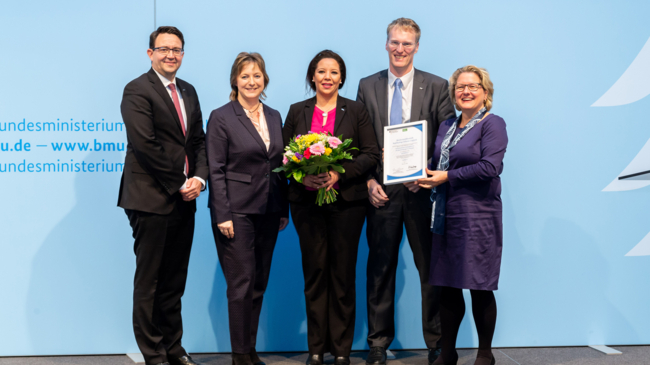
The award for sustainable city distribution was presented in Berlin by German Environment Minister Svenja Schulze.
Dachser's emission-free delivery is based on a modular 'toolbox'.Depending on the requirement profile of the city in question, the local Dachser branch can implement customised solutions.
Emission-free in Stuttgart
The winning project covers an area of about four square kilometres in Stuttgart city centre. Within this area, Dachser delivers all shipments without emissions. The electric FUSO eCanter delivers the groupage shipments directly to customers or brings them to a hub in cooperation with partner Velo CARRIER. There, the pallets are unloaded and transferred to electric swap-body bikes for delivery.
The charging point for the electric delivery methods is located at Dachser's Kornwestheim branch north of Stuttgart, which - like the logistics provider's other German branches - operates on hydropower.
Social and economic aspects
"With its combination of microhubs, electric cargo bikes and trucks, IT-controlled goods flow and route planning, Dachser has taken the initiative and is thus an important example in the market segment," the jury's verdict read. Dachser's emission-free solutions would take into account both social and economic aspects and are also implementable for other logistics service providers.
Dachser: 'Intensified cooperation needed'
"In the field of urban distribution, we have made a promising start in Stuttgart. But we still have a long way to go, especially when it comes to the availability of trucks with alternative drive systems," responds Stefan Hohm, Corporate Director Corporate Solutions, Research & Development at Dachser. In the future, Dachser also plans to implement a Daimler electric truck in its projects.
"For new, more sustainable inner-city distribution, all stakeholders need to cooperate more intensively. We are not looking for just one solution, but want to combine all possibilities so that we can increasingly optimise loading and unloading, our routes and delivery times.''











