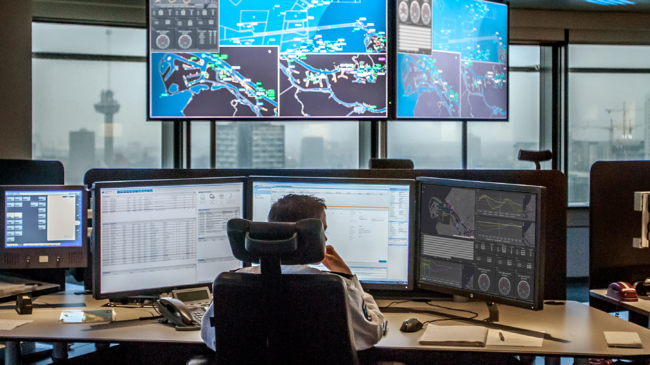
The Port of Rotterdam Authority has had a new Internet of Things platform developed. The first application provides the port with up-to-date water and weather data for ship traffic planning and management in particular.
Construction of the IoT platform took a year of work by IBM, Cisco, Esri and Axians and the Port Authority. Chief Operating Officer Ronald Paul calls the platform a "nice step in the development of Rotterdam as the smartest port"."However, equally important is that thanks to the cloud platform and the generated real-time information on e.g. infrastructure, water and weather conditions, we can further improve mission-critical processes in the services we provide to our customers."
Add new technologies
The generic building blocks that have now been implemented provide the Port of Rotterdam Authority with a basis to add new technologies at a rapid pace, such as edge computing, real-time analytics, artificial intelligence, hyper-precise data and blockchain. "This is necessary too, because the port area is still in the process of development, with, for example, new physical infrastructure taking on an increasingly digital aspect," the Port Authority writes in a press release. For example, sensors embedded on and in quay walls, mooring posts, (water) roads and traffic signs generate measurement data on a continuous basis and can communicate with other autonomous systems.
Accurate forecasting
Within the now-completed hydro/meteo system, data on water levels, currents, salinity, wind speed, wind direction and visibility are obtained through a combination of 44 sensors in the port, many forecast models, data from the Directorate-General for Public Works and Water Management and astronomical calculations. In doing so, the application helps reduce waiting times and optimise berthing, loading/unloading, and departure times. Thanks to the technology, for instance, the best time to dock and depart, depending on the water level, can be predicted more accurately, while guaranteeing maximum loading.
Linking easy for external parties
The Pilotage, Rijkswaterstaat, DCMR and various departments within the Port Authority use the hydro/meteo system. The number of users is expected to increase further. By using global and open standards, it would be easy for external parties to link to the real-time data.











