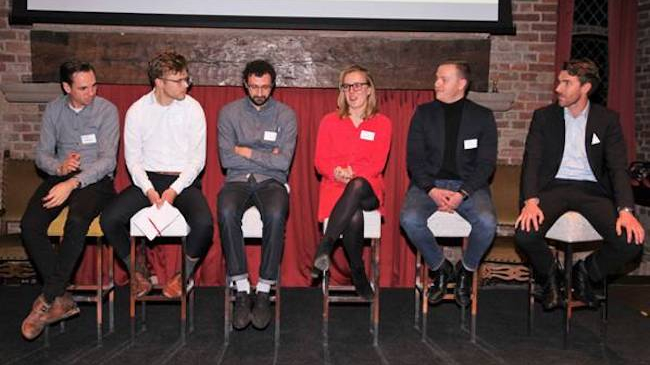
The 'war on talent' poses new questions for companies. Where do you find new supply chain talents? How do you bring them in? And what is needed to develop them further? SCELP's talent management working group put these questions to the talents themselves during their meeting on 26 November. What emerged: talents want space, but do not always get the desired trust. Guest speaker and management scientist Bas Kodden: "As a manager, take a step back and let talents take charge themselves. That is the highest form of leadership."
One thing the panel discussion with the six talents quickly made clear: a standard approach does not suffice. Among others, Peter Weijs, who started at DHL Supply Chain in 2016 as a management trainee, states that. "There are definitely talents in this trainee programme, but there are also many talents that only blossom after several years in another position. You miss those with a trainee programme." Colleague Robin Werner, who also started as a trainee at DHL, adds. "Your talent comes out best when you are given the freedom to chart your own path. Most talents themselves know pretty well what is needed for their further development. Not everyone fits into a standard programme."
Talents therefore like to be given space, like Faries Prins, demand planner at Nike. "Issues in supply chain are basically puzzles that professionals can fill in and solve themselves. The creativity required for this is what makes supply chain management so much fun. So give people the space to create that puzzle." He gets support from Weijs: "Throw talents in the deep end with at most a little help. But don't lay down exactly according to which rules an issue should be tackled." Werner: "Sometimes you have to let talents go head over heels and see how they surface again."
Coach or mentor
A good coach or mentor most appreciate. "Don't put them in an elite club, but pair them with experienced employees with the right attitude," argues Robbert Borsje, supply chain planner at Enza Zaden. "In certain areas, good guidance is indispensable, " says Tim Kalisvaart, strategic sourcing analyst at Yokogawa. "I used to work for a French and now for a Japanese company. Then it's nice if someone can explain how to deal with that Japanese culture." Prins adds: "It doesn't always have to be the direct manager who develops a talent. Sometimes the person you can learn the most from is in another team."
Susanne Nieuwenkamp, planning manager at Nike, calls on companies to pay more attention to the composition of teams. "Sometimes the members of a team do not fit well together. As a result, both the team and the talent do not perform well." Borsje advises companies to look closely at the person behind the talent. What does that person look like? What are his/her strengths? "And accept when a talent indicates what he is not good at," he says.
Self-efficacy
As the six talents profile themselves, they give the impression of scoring high on self-efficacy. According to management scientist Bas Kodden of Nyenrode Business University, this is the most important criterion when selecting talents. Talents possess self-efficacy if they are confident in the assessed skill required to perform a given task. "Often companies select on self-confidence, but many people have too much self-confidence. Self-efficacy means that people rely on their own strengths and allow others to take care of all the others," Kodden argues.
With an inspiring workshop, Kodden got the SCELP participants thinking. He showed the results of a survey among 50 ceos, who considered talent to be the most important selection criterion. But talent is not enough, as is often seen in sport. Character is much more important, especially engagement. "Inspired people want to perform and are always improving themselves. Most professionals in business are only inspired on day one. After a year and a half, only 12 per cent are. Most managers prefer to take the initiative themselves and are too often directive. As a result, they are themselves to blame for losing that engagement."
Giving space
Like the talents themselves, Kodden also advises giving talented professionals space. All managers need to do is facilitate and applaud in time. "Take a step back and let talents take charge themselves. That is the highest form of leadership. When talents are given space, results usually come naturally. If they still don't? Then ask your talents what you can do to make sure those results do come."
Image:The talents from left to right: Robin Werner, site manager DHL Supply Chain - Tim Kalisvaart, strategic sourcing analyst Yokogawa Europe - Faries Prins, demand planner Nike - Susanne Nieuwenkamp, planning manager Nike - Peter Weijs, project manager DHL Supply Chain - Robbert Borsje, supply chain planner Enza Zaden











