
Ordinary life in China is slowly getting back on track, and manufacturers, retailers and logistics service providers are noticing this too. Two-thirds of these companies in China are already running at least 80 per cent of capacity again.
Almost 60 per cent of companies indicate that their logistics chains upstream (delivery of components, partial products) have already returned to normal. The same goes for 47 per cent of logistics service providers.
This is according to a survey of 200 manufacturing, e-commerce and logistics service providers in China by consultancy firm Buck Consultants International (BCI), conducted around 24 March. According to Jeff Wang, director of BCI's Shanghai office, Chinese companies are still recovering from lockdowns and interrupted logistics chains. "But more than three-quarters hope to have their logistics chains fully back to normal within eight weeks, which is an encouraging expectation."
The crisis has made many companies realise that supply chain reorganisation is inevitable. "With more than 90 per cent of companies looking to reduce risks in their supply chains, there is a huge task ahead to improve the robustness of today's and tomorrow's supply chains," said Patrick Haex, managing partner at Buck Consultants International.
Figure A: Answers to the question:What do you think your company will focus on to improve the robustness of supply chains (multiple answers possible)?
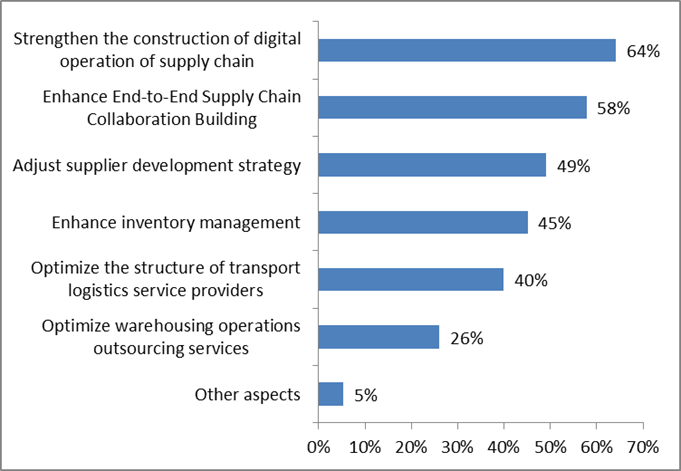
In particular, the development of digital twins of physical logistics chains to increase visibility throughout the chain and strengthening cooperation between all links in the chains are priorities for the companies surveyed. "Building robust end-to-end logistics chains is a multidimensional task. It includes data-driven control towers to monitor shipment, order and delivery data so that proactive action can be taken. But also spreading component deliveries across multiple suppliers - with quality and delivery security at the heart of it - is important," Haex concludes.











