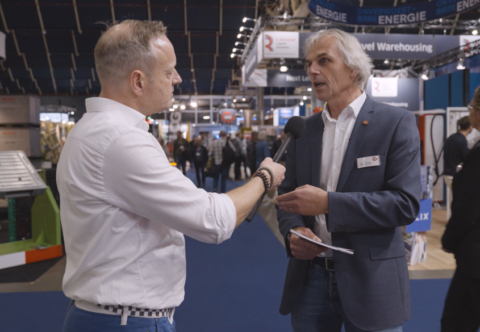
Every week, LogistiekProfs lets a logistics professional speak about his expertise. In this triptych, Peter van Minnen, ict & logistics consultant, advises on the deployment of barcode projects. Is it profitable for your logistics operations to use barcodes?
The latest economic crises plus the Internet have changed the way we look at business and put business on edge. The air is out, there is less money for investment and belts have been tightened.There are noises that we have now had the worst of it and that the economy is picking up. That's great, we're going back to work. But better and smarter than before. We have learned from the crisis, right?With less time and people, we need to work better and faster. That should be possible. The information below aims to help with that. But your situation determines whether this information is relevant.
- As an entrepreneur, do you have a (small) warehouse?
- Do you have at least 1 service vehicle or field staff?
- Can barcodes increase your service quality?
- Can barcodes improve process efficiency?
- Want to improve without expensive consultants?
- Should the solution be smart and easy to understand?
It is easier to start using barcodes in a small company than in a large one where everyone has to have a say. Take advantage of that. On the other hand, a barcode project in small businesses may cost next to nothing. Fortunately, there are solutions to this, but think before you start!
Introduction Barcoding
In recent years, the barcode has made its appearance, become big and is now accepted around the world as a means of identifying products and simplifying trade.
A tremendous amount of time was invested by large international companies and supermarket chains to arrive at standards and agreements. Manufacturers of scanners and printers fell over each other to answer the demand for barcodes with even better products at ever lower prices.
Meanwhile, the term Supply Chain Management is gaining momentum: this is where consultants and logistics advisers at multinationals can still make a lot of money. This is where big companies are still investing a lot. And that's a good thing!
The benefits of barcodes are great. However, introducing barcodes within business processes was normally a costly affair and required a lot of consultation and coordination. And so it could be that mainly large companies deploy barcodes and seize the benefits.
But those days are now over: things have changed! The new approach is no longer to impose from the top down, but to grow from the bottom up. An incremental approach instead of a big-bang. A growth model rather than an investment, with the hope of returns. It is now about operations rather than technology.
So who in particular is this story aimed at? For entrepreneurs who agree with the following points:
- For stock registration
- Receiving deliveries
- Internal transfers
- Delivery of materials
- As an alternative to annual balance sheets
- For small business owners
- who don’t have the time or money for large and complicated projects
- who work with MS Office
- who focus on their customers
- who do their administration and bookkeeping on their PC
- In small and medium-sized businesses
- Where stock levels are sometimes out of sync
- With both an office and a warehouse
- Possibly with service engineers using their own equipment
- Who need to be flexible, but also accurate
- In departments
- In public sector organisations, where projects can sometimes take years
- In multinationals, where deviations from the ERP system are not permitted
- Such as operating companies or local branches
It doesn't matter what industry you work in or how big your company is. Working with barcodes means nothing more or less than organising processes. As simple as it sounds, it is.
Starting with barcodes, barcoding, is like starting a big journey: it starts with the first step. You can't plan a journey down to every level; something unexpected always happens. It is no different with barcoding. Always you have to be able to take a step back without starting again. A little to the left or to the right, immediately if circumstances call for it. Flexible. Adaptive. Without project teams. Independent.
The first step in barcoding is cheap, striking in its simplicity and very versatile in its application. You set it up for goods receiving or for goods issuing. Then for inventory assistance. You start with packaging or for raw materials or service cars. A bit more each time. And each next step can be assessed immediately. Learning without disinvestment. We don't have time or money for that.
Be critical
Listen to others, think and don't let anything fool you. You can always spend money on nonsense. In traffic, the same applies: when in doubt, don't overtake. Better home later than in hospital.
Take a moment, 5 or 10 minutes, to see if we are talking sense or nonsense. Do this before all parties and interested parties start spending time and money on preliminary studies, research, unnecessary travelling back and forth and needless phone calls ("we are busy now, please call us back next week").
In the following overview of 2 x 10 points, we separate the sense from the nonsense. Consider the contribution to efficiency and quality.
What your potential supplier should research:
- whether you have a warehouse and whether the stock data is correct
- how many people have access to the stock
- how often and how much is received and delivered
- whether you can leave the receiving, stocking and delivery to others
- how often and at what cost stock-taking is carried out
- whether deliveries are ever made incorrectly (and what that costs)
- whether duplicate orders are ever placed (costs)
- Whether you’re already using barcodes or think that barcode scanning could be helpful
- whether your accounting software can handle barcodes and stock
- how much money you have available or can set aside for improvements
What you should ask yourself:
- How reliable is the supplier?
- Does the supplier offer similar advice / solutions, or is this a one-off?
- Can what is claimed actually be seen or tested in practice?
- Can it be applied in everyday practice?
- Have you ever had a failure? How and why? Is that the only way, or is there another option?
- Is there convincing evidence from third parties that it works and is successful?
- Does he operate openly and honestly? No skeletons in the cupboard or hidden costs?
- Does he provide positive evidence that his method works or that the other one doesn’t?
- Does it actually help us, or does it just make the work a bit different?
- Is it about your own success or that of the supplier?
In the next article, we discuss exactly what barcoding can bring you. What can a project cost to still be profitable?
Peter van Minnen - ict & logistics consultant, article identification specialist