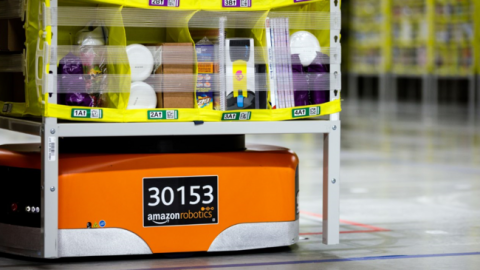
Companies are increasingly showing interest in automated and mechanised storage and order picking systems. These systems are becoming cheaper and are increasingly scalable and flexible, making them more attractive to companies, especially those active in e-commerce.
During the Logistica trade fair, many new developments in the field of scalability and flexibility in systems will be shown. A tour of logistics experts shows that they too have noticed an increasing interest in automation and mechanisation.
Good business case
This is said to be mainly due to the attractive return on investment of automated storage and order picking systems. "The business case is simply good in many cases, provided companies have a long-term view. In the short term, investments in these kinds of systems are often not yet recoverable," states René de Koster, professor of logistics and operations management at Erasmus University Rotterdam and chairman of the Logistica Foundation.
Alarik Lens van Rijn, director of system integrator Costo and also present at Logistica, also notes that companies tend to have shorter and shorter depreciation periods. This places additional demands on automation solutions. "These do need to be flexible and scalable," Lens van Rijn says. He does notice that the costs of automation and mechanisation are getting lower and lower, mainly due to rapid developments in consumer electronics. "Look what you can't do with a smartphone these days. Those developments are seeping into industry. A wifi module of an order picker costs only 20 per cent of the price of five years ago," Lens van Rijn explains.
Read also:Internet of Things also conquers logistics
Multiplication of operations
The increasing interest in automation and mechanisation is mainly due to the growth of e-commerce. So says René Wolters, managing director of Knapp Benelux, the company that, among other things, supplied the storage and order picking system for the new Wehkamp DC. "Our turnover grew by 20 per cent last year, and this growth came mainly from online retailers. There are also some serious e-commerce projects in the pipeline in the food sector."
The interest in automation in the e-commerce sector is readily explainable, says Wolters. "It makes quite a difference whether you send a carton of 12 pairs of shoes to a shop or whether you have to ship those 12 pairs all separately to different consumers. E-commerce leads to a multiplication of logistics operations in distribution centres, and that makes automation rather interesting."
Erratic peaks
Webshops often still experience erratic peaks in order patterns. But according to Wolters, this does not necessarily mean that automation is not possible. "Indeed, many consumers place their online orders in the weekend, but companies are increasingly responding by starting order picking on Sunday, for example, instead of saving all orders until Monday morning. And it is true that relatively many orders are placed in the evening after working hours, but we also see many orders in the lunch break or in the morning when the children are at school. The spread of orders throughout the day al only improve when online shops start introducing sameday delivery."
Even companies that until recently were reluctant when it came to automation are becoming increasingly interested in this technology. This also applies to logistics service providers, for example; automation is a way for them to reduce operational costs, improve quality and thus add more value in the chain. "The problem is that they often struggle with short-term contracts with clients. A five-year contract is already long. Even if an investment pays for itself after five years, the service provider has still not earned anything."
Interested in attending Logistica? You can register for the fair for free here.
Editorial LogistiekProfs