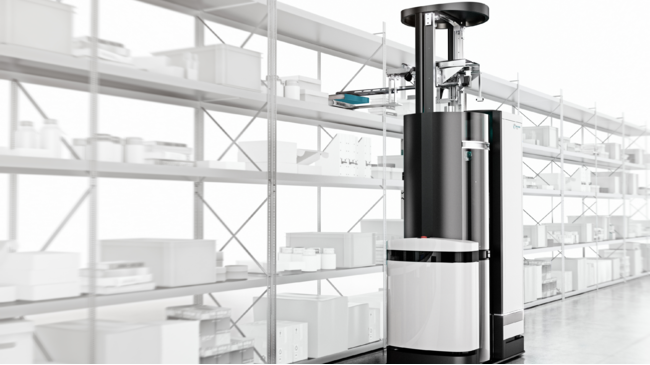
In the south of Germany, a robot is currently driving that can pick eighty books per hour from shelf racks completely independently. This robot - basically an AGV with a gripper arm - is a development of Magazino, a Munich-based start-up. Developments are going fast, say the people at Magazino. "By the middle of this year, we expect to be at 120 picks per hour," they say.
The TORU Cube, as the robot is called, finds its way through a warehouse of shelf racks completely independently. It drives to the right picking location, grabs the ordered book from the shelf and places it in a rack with room for more than 20 books. When the rack is full, the robot drives to a packing table where the books can be taken out or the entire rack exchanged.
The robot now does that trick eighty times an hour. "An ideal robot for picking single-line orders in webshop warehouses," one of the developers told me during a preview of CeMAT, the trade fair taking place from 31 May to 3 June in Hanover. Those who do not want to wait that long can already see the TORU Cube at work at LogiMAT, the trade fair in Stuttgart scheduled for 8 to 10 March.
Robots in the warehouse have long existed in the form of shuttles or AGVs that bring totes of items to an order picking station. In these applications, human hands are still needed to pick the right number of items from the totes and place them in shipping boxes. What makes the TORU Cube unique is that it also takes over this operation. A human is no longer needed to fully automatically pick books from a warehouse and put them in a box.
The TORU Cube does not only handle books, but all kinds of rectangular items up to shoe boxes. It can grab items from any shelf location between 10 and 209 centimetres in height. And what makes this solution scalable: it can operate between people. So if the number of orders is too large for the number of robots, temporary workers can easily be added.
A second practical test of the robot in the warehouse of Sigloch, a book distributor in Blaufelden, Germany, was successful: the robot was able to change aisles independently, recognise each book and pick it up correctly. The robot's speed: one metre per second, double compared to an initial field test. The intention is to have the first robots at Sigloch fully operational next spring.
Magazino is not the only party developing an order picking robot. Operating in the US is Fetch Robotics, a start-up that managed to raise $23 million in an investment round last year. Both start-ups are keeping a close eye on each other. "Fetch Robotics uses an articulated arm robot that is more flexible than our gripper, but therefore slower. Currently, we can process an estimated 20 per cent of products. In five years, it should be eighty per cent."
Remarkably, Fetch Robotics is also developing an alternative robot application that may be more market-ready: a robot that closely follows a human order picker with one or more totes, so that the order picker does not have to carry a trolley himself. The advantage: when the totes are full, one robot can take them away, while another is already waiting with a stack of empty totes.
A similar solution from Locus Robotics - not to be confused with the Dutch warehouse management system of the same name - was installed in November at Quiet Logistics, a US fulfilment specialist that works for Zara, among others. A fleet of robots at this company appears to work in conjunction with order pickers, allowing them to achieve more picks and walk less.
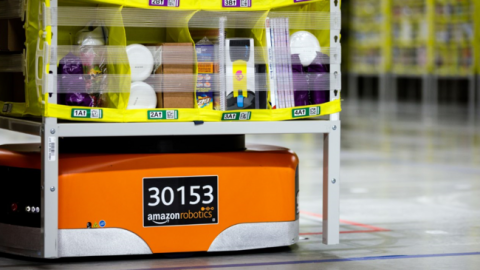
The question is whether these robot applications are now the solutions that logistics is waiting for. They allow order pickers to walk less and may not even be needed in the long run, but the robots still have to cover long distances. We may no longer have a man-to-commodity system, but we do have a robot-to-commodity system. So we are waiting for the first application of Magazino and Fetch Robotics' robots in combination with Kiva's robots. Then we will have a tangle of robots, some with gripping arms and others with racking units, criss-crossing each other and getting orders ready for shipment even faster.
Marcel te Lindert - journalist logistics and supply chain
Stay up to date
Sign up now for the LogistiekProfs newsletter and receive the latest news, trends and offers.