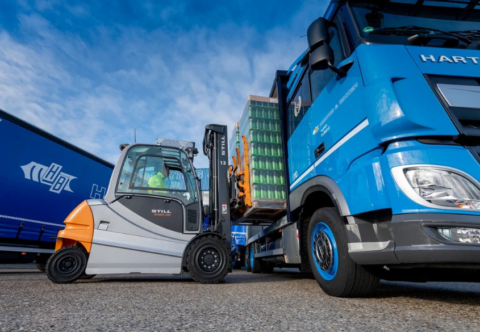
Of course, safe working begins and ends with the forklift driver. Whatever measures we take, even with the safest forklift in the safest warehouse, accidents are still possible. Nevertheless, technical aids can indeed help increase safety. In this part, we list five tools for you. Five more will follow in part two.
- Show yourself
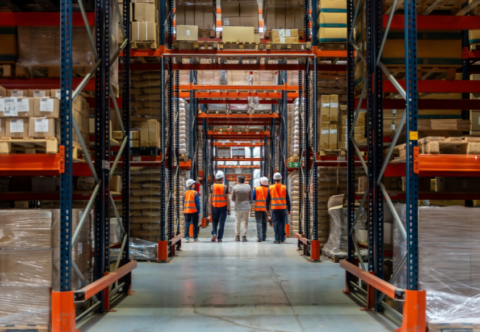
Four out of 10 forklift accidents involve a pedestrian. The problem is that pedestrians' visibility often leaves much to be desired. This is especially true for men in grey suits who are also unknown in the warehouse. A simple and inexpensive measure is to put on a fluorescent safety vest, which often makes pedestrians visible from a great distance. For regular warehouse workers, company clothing in bright signal colours, possibly with reflective stripes, is a good alternative. - Look in the mirror
Fluorescent vests obviously do not help when pedestrians are hidden behind packed pallet racks or other obstacles. In that case, convex mirrors at obscure points can be a godsend. Bulb mirrors make it possible to see around the corner of a rack from any direction and from any distance. Of course, fluorescent vests and signal colours also help here to quickly signal approaching pedestrians in the small mirror image of convex mirrors. - Warning with light signals
When reversing, visibility remains a problem. A forklift driver looking over his right shoulder can see pedestrians and other traffic coming from the left quite well. It is different with traffic from the right, which from the driver's point of view comes from a 'blind spot'. Forklift trucks therefore emit an audible signal when put into 'reverse'. A popular alternative is an LED light on the cage structure - with names like bluespot or floorspot - which projects a generally blue beam of light onto the floor while reversing. Pedestrians who cannot yet see the truck itself are alerted by the usually rapidly approaching spot of light. - Watching with cameras
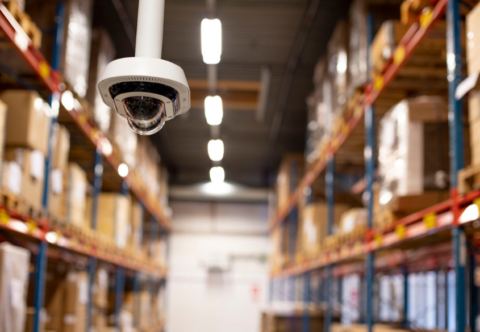
Another problem remains visibility at high altitudes. Anyone who has ever put away a pallet at a height of 11 metres with a reach truck knows the problem. In such a situation, try estimating the height correctly from the driver's seat. If you fail to position the forks accurately, the pallet is likely to fall down. A camera on the fork carriage combined with a monitor in the cabin gives the driver the visibility he needs to pick up or put away pallets at great heights. - Throw blockades at
Cargo can also fall when drivers try to place a pallet in locations that are not large enough. For example, consider those few locations on the top girders of pallet racks that are less high than surrounding locations because of pipes, rafters or ventilation grills. In warehouses where drivers are controlled by a warehouse management system (WMS), it is possible to block these locations with the software. That means no driver is ever instructed to place a pallet there again. If that goes too far, the WMS can be configured to take into account the height of the pallet and the storage location during inbound operations.
TOM van BLOM - Material handling expert
In a forthcoming article, Tom van Blom discusses the other 5 tools you can use to increase safety in the warehouse.
Always stay informed
Sign up now for the LogistiekProfs newsletter and receive the latest news, trends and offers.