The finalists of Logistics Manager of the Year 2016 can breathe easy again. At least, for a while. Their presentations are behind them and now the wait is on for the judges' results, which follow at 18:00 this afternoon. We list the highlights for you.
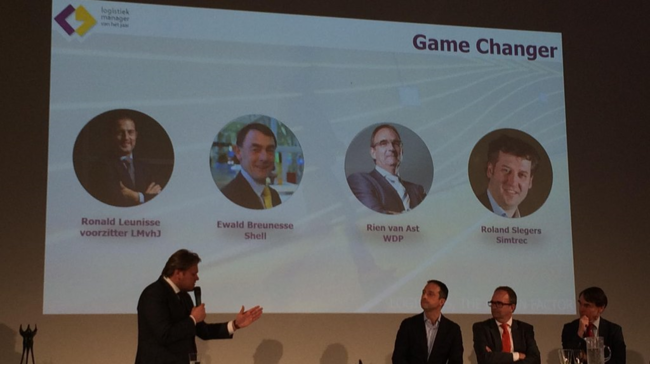
The final day kicked off with a debate around the Game Changer theme (pictured) with Ronald Leunisse (DHL), Ewald Breunesse (Shell), Roland Slegers (Simtrec) and Rien van Ast (WDP Netherlands). In it, Leunisse stressed that logistics people are still too modest about their role in the business process. After the short debate, the finalists of Logistics Manager of the Year (LMvhJ) and Young Logistics Talent (JLT) were given ten minutes each to present themselves one last time. Among the three young logistics talents, the audience also played a big role. After each pitch, the audience was allowed to judge the finalist. This assessment will ultimately determine 50 per cent of the final score.
Young Logistics Talent
In the Young Logistics Talent category, Daniella Beljaars bit the bullet. The owner of BB Logistiek was nominated by her proud husband. With her company, Beljaars aims to provide SMEs, a sector overlooked by many logistics service providers, with full logistics relief. According to Beljaars, her company is a Game Changer because of the following three pillars: focus on SMEs, service orientation and a personal touch. For instance, after every first delivery, Daniella brings a homemade apple pie to the customer and then evaluates it together. "For that baking, with some 60 regular customers, I am now too busy. My grandmother has now taken over that," Daniella confessed.
After this, Stefan Kleijngeld, Manager Logistics at WP Haton, entered the stage. After his internship at WP Haton, Kleijngeld was asked if he would actually put the findings in his thesis into practice at the company. "I actually found that very scary, but this had always been my dream, so I decided to do it anyway." So when you focus on the goal, the boundaries blur, Kleijngeld's motto goes. A good example of logistics as a game changer are the 'packaging on wheels' introduced by WP Haton. "Earlier, all delivered parts had to be packaged separately. That not only cost money, but also a lot of time. We therefore developed custom-made trolleys with soft partitions, so that the parts can be transported unpackaged."
Finalist Bart Louwen, supply chain manager at VBH Netherlands, told the jury and the audience that he likes to compare logistics to an iceberg. "Only the tip of the iceberg is visible to the outside world, while this is only a very small part of logistics. Traditionally, logistics focuses mainly on the processes that are not visible. I want to change that." Louwen has therefore visited a customer at least once every week for the past year, to actively think along with customers. An example is the project with service buses. "VBH Netherlands has a number of customers who use service buses to take care of repairs. In the old situation, at the beginning of his working day, the mechanic drives a bus to the central warehouse, where he gets the materials. We have reversed that process: we make sure the materials are delivered to the bus even before the mechanic starts work."
Logistics Manager of the Year
Following this, the LMvhJ finalists took to the stage. Eric Armstrang, responsible for the transport and packaging of medical devices at Philips Healthtech, was first up. In his presentation, Armstrang illustrated a well-known packaging problem with a large box that was delivered to his home last week. In a small corner of this box, he found his new mobile phone, which arrived at his home broken. A problem that was also common at Philips when delivering spare parts. Because each supplier determined the packaging of equipment itself, parts often arrived damaged. Moreover, because the packaging was too large, a lot of air was transported. At Philips, Armstrang therefore introduced a system of 25 packages that suppliers had to adhere to. This not only reduced costs, but also significantly reduced customer complaints.
Carin Hendriksen, manager of manufacturing and warehouse operations at Omron, likes to compete with China, she says in her pitch. At Omron, Hendriksen has been responsible for the logistics processes for a few years now. "When I just started doing this, there was little structure. For example, there were no walking routes. I changed that." Perhaps the most recognisable change is that the team started working on the floor, among the operational processes. Her use of Lean improved productivity by 60 per cent within three years and reduced direct costs per order line by 30 per cent. And competing with China succeeded, as the Omron factory in 's Hertogenbosch managed to reduce its production costs by 10 per cent compared to China.
For Iwan te Winkel, director of logistics at Raab Karcher, the challenge was to use logistics as a game changer in the construction industry, a sector that Te Winkel says is very conservative. "The construction industry sees logistics mainly as a cost item. Time to change that." Within construction, there would be two major needs: solving space shortages in inner-city construction and raising the productivity of skilled workers. Te Winkel therefore developed the logistics concept Leanworks, a new approach to the distribution of materials to the construction site. With Leanworks, materials are also brought to the construction site from third parties and via Raab Karcher's hub. "Because the materials are brought to the craftsman's workplace, the productivity of construction workers goes up significantly and less storage is required."
At 18:00, the winners of the LMvhJ and JLT will be announced. We will keep you informed via LogistiekProfs.
Editorial LogistiekProfs











