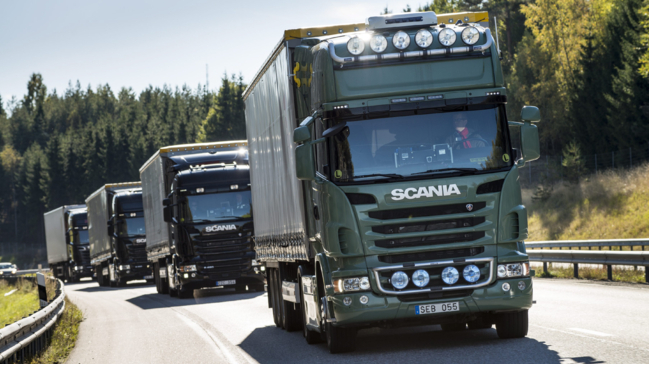
Dutch supermarkets do see bread in truck platooning. Albert Heijn, Jumbo and Unilever want to conduct tests in the near future in which products are transported by trucks that are part of truck platooning. The companies made this known during the European Truck Platooning Challenge held this week.
In truck platooning, trucks drive in a train behind each other while connected via Wi-Fi, following each other's movements and speed, thus driving more efficiently. Through this new way of driving, up to 10 per cent less fuel can be consumed and CO2 emissions are significantly reduced.
Challenge
During the Challenge, which was organised by Rijkswaterstaat, Daf Trucks, Daimler Trucks, Iveco, MAN Truck & Bus, Scania and Volvo Group crossed national borders. The cross-border crossing of this platoon is a world first. The trucks drove from Sweden, Germany and Belgium to Rotterdam. The test revealed that a lot still needs to be tuned, such as procedures that differ from country to country. Also, each truck manufacturer has its own wifi system and many different applications must now be made to actually be allowed to drive on the highways as a truck platoon. The stumbling block that required trucks to change licence plates at the border has already been overcome, however.
Opportunities
Minister Schultz van Haegen sees many opportunities for platooning. "Truck platooning ensures more efficient and cleaner transport. Self-driving vehicles also contribute to road safety because most road accidents are now the result of human error. This test has shown that a lot is already technically possible. The test has also made it clear that we in Europe need to better align road and driver rules to make cross-border transport with truck platooning possible on a larger scale." The experiences are thus very useful for the informal Transport Council on 14 April in Amsterdam, where I will discuss with my European colleagues the adjustments needed to make self-driving transport possible."
Editorial LogistiekProfs











