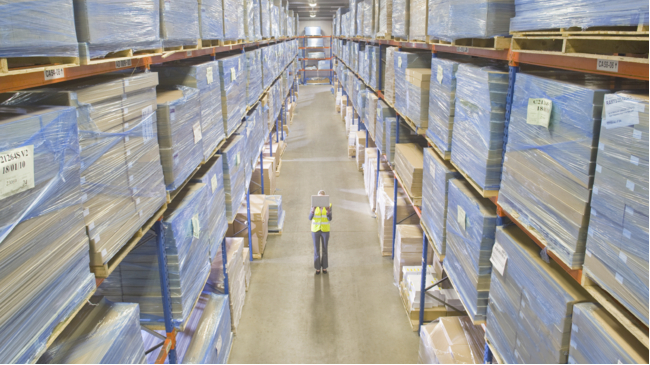
Not infrequently, we are asked to design a new warehouse because the existing one is bursting at the seams and the throughput capacity has become too low to handle the growing flow of shrinking orders. A legitimate reason to start a new-build project, you might say.
An important part of such a process is a data analysis, which provides not only the optimal logistics concept but also the most important design criteria. These include the required number of loading docks, the number of pallet racks for inbound and outbound flows and, of course, the number of racks. In most design processes, these storage requirements are determined on the basis of 1 or more stock 'snapshots' prior to a busy period. Those numbers are translated into pallet, box and small goods storage and then multiplied by the expected growth rates. Dimensions and layout of the new warehouse are thus laid down but it often turns out afterwards that wrong choices were made. Is this due to the calculations?
Wrong starting point
With a background in inventory optimisation, it never ceases to amaze me that inventory is usually a static figure that is hardly discussed, whereas order frequency, optimal order quantities and turnover rates are key drivers for good warehouse design.
The starting point in a new design should never be the (over)stock that is there now but should be based on the optimal stock that should be there to achieve the desired service level. It sounds so logical but it rarely happens, often due to a lack of knowledge, cooperation and the right supporting software.
And the impact on the warehouse is bigger than you think.
Lower throughput
Not only do warehouses become oversized by extrapolating bad stock but it also results in wrong choices for the order picking and storage concept.
The best example is seen in retail warehouses that have gradually taken on the character of a wholesale warehouse. Wrong stock and the associated rising storage requirements and falling turnover rates soon lead to Very Narrow Aisle (VNA) technology as the ideal choice with far-reaching consequences:
- Limited throughput because only 1 VNA truck can be present in an aisle
- More labour because a handshake is always needed between the VNA truck and a reach truck for pallet supply and removal.
- Sharply higher investment in VNA trucks compared to conventional reach trucks.
If, after completion, it is decided to start improving inventory integrally by having Purchasing and Warehousing work together in one Supply Chain department, reducing delivery times by buying locally (slightly more expensively) and applying dynamic forecasting methodologies, then availability and turnover rates will start to increase to everyone's delight.
Unfortunately, the number of dock doors then turns out not to be sufficient due to more frequent deliveries and the new narrow aisle warehouse (or the automatic pallet cranes with double-deep storage) is the biggest bottleneck due to too limited throughput.
It is therefore advisable to immediately use new-build plans as a capstone for improving inventory and include the potential for savings as a starting point in the design.
Robert van Ree - Senior Logistics Consultant at St Onge Company
Stay up to date
Sign up for the newsletter and receive the latest news, trends, innovations and developments from the sector.











