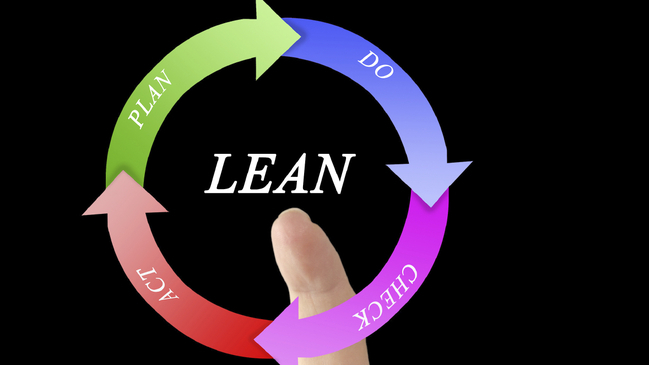
Many companies today fully embrace the Lean idea. One of the tenets of Lean, eliminating avoidable waste (or waste) from processes, is already taken for granted in many corporate cultures.
Yet at FPC beyond packaging, we still see avoidable waste being overlooked. With each of the 5 Lean principles, optimisation opportunities are being missed by starting from the wrong starting point:
1. Define value
This first step in the Lean philosophy often focuses on the products and services themselves. It looks at what they should be able to do and do in the eyes of the customer. However, the packaging of goods also influences the customer's perception of value. Take for example the packaging of today's smart phones, here the packaging has now become part of the product.
Conversely, when products arrive in faulty packaging, the customer sees this as a depreciation in the value of the overall product. Phenomena such as wrong delivery due to a labelling error on the box and arriving late or damaged due to inadequate packaging are also relevant here. These issues often cause a sharp drop in value perception.
A uniform and professional appearance of packaging contributes to a sense of quality. Thus, packaging represents an opportunity to increase value for the customer.
2. Map the value stream
When mapping the value stream, often not all packaging-related wastes surface. This is caused first of all by looking within your own company or warehouse but not outside it. Much unnecessary waste in your process occurs when the next link in the chain has a different packaging and/or labelling requirement. By making agreements with chain partners, this can be prevented.
In addition, the focus is often too quickly on (production) activities and operations. However, in terms of packaging, there is also a large waste component "in the box". How much air do you send out because your employees don't know which is the best fitting box? This can add up considerably in terms of transport costs alone.
An example: of all the products a company sends out on an annual basis, 10 per cent go to their final destination via air freight. To pack appropriately for air cargo, much more buffer material needs to be used. However, the packer does not know at the time of packing what the mode of transport will be. Therefore, 100 per cent of goods are packed "worst case" and thus 90 per cent of shipments could be more efficient and cheaper.
3. Uninterrupted flow
Within the Lean management philosophy, the third step aims to ensure an uninterrupted flow of the product or service through the chain. This is achieved by eliminating waste from this flow. Interruptions in that physical flow are more often than thought caused by irregularities in the packaging process.
As an example, repackaging frequently occurs because suppliers have a different packaging unit than what the customer ultimately requests. This is often seen as a form of waste that cannot be avoided. But what if you can tell the supplier how to pack according to your specification? The technology is available for this today.
4. Just in time: from push to pull
According to the fourth Lean principle, overproduction should be avoided. In other words, organisations shift from a push to a pull (production) orientation.
That this "Just in time" principle puts a time pressure on packaging products is often overlooked. If we assume that the activity of packaging takes place at the end of production and often immediately prior to shipping, that is where the bottleneck occurs. Because there is no buffer stock, everything has to be packed at such a pace that transport cutoff times are met.
This can only be done by working with correctly defined packaging instructions and a clear packaging range. Otherwise, this time pressure can just lead to incorrect or faulty packaging of products to meet the cutoff time, or missing the cutoff time.
5. Keep striving for perfection
Continuous Improvement, and linked to it, creating conditions for a culture in which these continuous improvements can take place is a key component of Lean management.
Especially in the field of packaging, this is essential. This playing field is so dynamic because the frequency of newly introduced variables (products, suppliers, destinations, customer requirements, etc.) is very high. Moving with those changes is therefore a must.
On the shop floor are usually the people who first recognise a possible improvement. Therefore, leverage that information and facilitate solutions to aggregate and deploy it.
Packaging integral part of Lean management
As you can see, packaging is an integral part of Lean management thinking. If this is underestimated, it leads to avoidable waste being overlooked and thus some of the potential of your Lean programme remains untapped.
Mark Ruiter - Business Development Director Faes Packaging Consultants (FPC)
Stay up to date
Sign up for the newsletter and receive the latest news, trends, innovations and developments from the sector.











