Without smart glasses or an app, you don’t count as a
supplier of logistics systems and tools. At least, that’s the impression
emerges after a day spent walking around the international trade fair CeMAT. Even the
traditional suppliers of ‘hardware and wheels’ are making use of smart glasses and apps.
Practice will tell whether these tools – including the odd drone – are more than
than just a fun gadget.
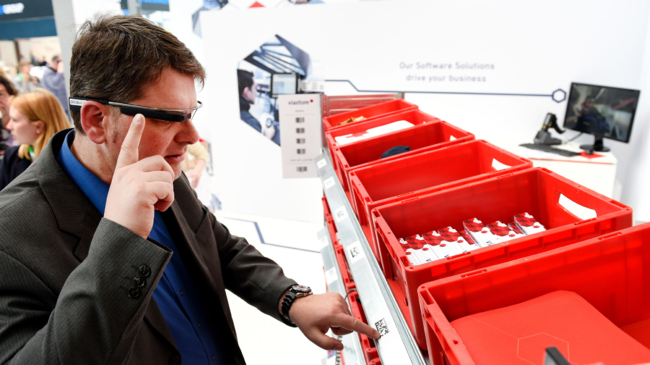
First of all, the smart glasses, which are on display in two versions at the trade fair
. The most common are the Google Glass-style glasses that
project a small screen into the wearer’s field of vision. Exhibitors of warehouse
management and order-picking systems are inviting visitors in droves to try them on
, whilst onlookers can watch along on a large screen.
What the wearers then see is usually a screen displaying
instructions for order pickers, such as the pick location and the number of items.
It is striking that they often fiddle with the glasses for a moment before they
actually see what they’re supposed to see.
Not new
The use of smart glasses for order picking is not
new. Eight years ago, the concept was first showcased at the trade fair in Hanover
. The fact that the glasses are now being demonstrated on such a large scale proves that
the technology has improved and is easier to implement. Several
several companies have already implemented ‘pick-by-vision’. It is a
order-picking method in which, just as with voice picking, order pickers
. The difference is that the instructions remain visible and do not, as
with order picking using a headset, where they disappear once they have been spoken.
Judging by CeMAT, the time now seems ripe for large-scale
implementations.
Visualisation
Alongside the numerous Google Glasses, there are a striking number of
Oculus Rift headsets on display. Visitors who put on these headsets can
wander around a virtual warehouse. When they turn their head to the left or right
, the image displayed by the glasses rotates completely in sync. It is mainly the
warehouse design specialists who have fully embraced this technology in collaboration with
3D simulation specialists. They demonstrate what a warehouse
will look like once their concept has been implemented. This is particularly helpful in
convince stakeholders – such as senior management unfamiliar with modern logistics
systems – of the usefulness and necessity of the concept. They can
wander around their own warehouse of the future and see how people and goods
move around.
Logistics apps
Anyone unable to demonstrate smart glasses will have
smartphones or tablets to demonstrate logistics apps. Apps offer many advantages,
such as the ease with which they can be installed and used. The
development of apps often takes little time and is therefore relatively inexpensive. What they
usually do is unlock information that is locked away in other
systems. A few examples:
· Still has no fewer than nine
apps that provide users with insights into information from the new
Still neXXt fleet fleet management system. There are separate apps that provide insights into, amongst other things,
costs, maintenance planning, operating hours and usage.
· Jungheinrich has a
Call4Service app. Customers with a faulty forklift or warehouse truck can use their
smartphone to take a photo of the damage and the unique QR code on the truck and
request a service engineer from Jungheinrich.
· A-Safe is launching an app that
alerts users if a forklift truck has collided with a warehouse racking unit.
To achieve this, A-Safe fits impact sensors to the racking uprights, which immediately
alert in the event of a collision. This app therefore also warns of
damage to racking that would otherwise have gone unnoticed.
· Various
software providers, such as the Swiss firm Scandit, are showcasing apps for
barcode scanning in warehouses, including for order picking and
stock management.
Drones in the warehouse
A relatively new development when it comes to gadgets in the warehouse
are drones. A few organisations are already experimenting with the use of drones for
taking stock, but the Fraunhofer Institute for Material Flow and
Logistics is taking it a step further. This Dortmund-based research institute
has devised a concept in which drones are used for order picking. The
drones are fitted with a spherical basket, into which the goods can be
transported to a packing table. Is this already a fully functional
concept? No, but then again, ‘pick-by-vision’ using smart glasses wasn’t either
wasn’t either.
Marcel te Lindert - journalist logistics and supply chain
Stay up to date
Sign up for the newsletter and receive the latest news, trends, innovations and developments from the sector.











