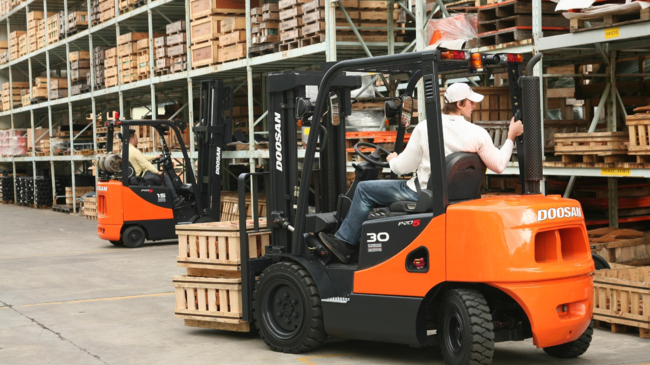
Even before 2016 is halfway through, we’ve already recorded six fatalities
in accidents involving forklift trucks. That is more than the number of fatalities usually recorded in a
whole year. Research shows that by no means all forklift truck drivers have
received training, whilst training operators should be a key
step in creating a safe working environment.
In Rotterdam, a woman was killed by a forklift truck.
In Schijndel, a man was killed whilst carrying out loading and unloading work with a
forklift truck. In Bergharen, a man was killed by a steel beam whilst loading with
a forklift truck. In Nunspeet, a man lost his life after falling from a height whilst
a forklift truck. These are just a few examples of accidents involving forklift trucks
that have taken place this year. If the trend from the first half of the year
continues, we will break the record for the number of fatalities this year.
We can only speculate as to the causes of the rise. Is it
a coincidence that the rise in the number of fatalities coincides with the
economic recovery and the increase in logistics activities in
the Netherlands? Is the workload in warehouses increasing as a result? Are we now relying more than
previous years are we relying on forklift truck drivers with no experience and perhaps
without any training as well?
Impaired driving ability
Damyam van Doornik, an instructor at BLOM Opleidingen,
has, as part of his training to become a senior safety officer,
, carried out research into the added value of forklift truck training courses. This
shows, amongst other things, that 82 of the 1,176 offences identified by the Inspectorate for Social Affairs and Employment (SZW) in 2014
related to drivers who had not been adequately
trained. So there are still plenty of them: companies with drivers who have not
taught how to operate a forklift truck safely.
An analysis of 1,660 accidents over a 13-year period shows
that in 61 per cent of cases, driving ability was at fault, for example because
drivers were distracted, behaved inappropriately or accidentally activated certain functions
of the lorry. Of course, even drivers with
training can be distracted or accidentally set the vehicle in motion.
Training is no guarantee that a driver will always act safely. However,
good training, which is repeated periodically, does lead to greater
safety awareness.
has been declared bankrupt. As well as fatal accidents, the lack of
forklift training also have financial consequences. The Inspectorate of Social Affairs and Employment may
impose fines of €450 on the driver and between €3,000 and €15,000 on the
employer. Furthermore, the improper use of forklift trucks can lead to damage
to goods and equipment.
The indirect costs in the event of an accident are often
even higher, as illustrated by the story of a company in Amersfoort. A
forklift truck at this company ran over an employee’s foot,
resulting in a crushed foot. As the driver had not received any training,
the court ruled that the employer was entirely at fault
and must compensate the employee. The company, which had four employees, was
was eventually declared bankrupt as a result of the financial consequences.
’s step-by-step planVan Doornik has drawn up a step-by-step plan to help
companies can significantly improve their safety:
1. Send all
forklift truck drivers to an accredited training provider.
2. Stop work
if unsafe situations arise.
3. Make ‘forklift trucks’ a
regular agenda item at toolbox meetings, work briefings and meetings.
4. Have drivers
starting work.
5. Managers play a
important role to play. Assess their safety-related competencies with an
assessment.
6. Continue to assess the skills of
drivers’ skills against a skills checklist, even after they have completed their training.
7. Carry out audits using internal
and, where appropriate, external specialists.
A cost calculation shows that this step-by-step plan, in an
environment with a single forklift truck driver costs just over a thousand euros a year.
The greater the number of forklift trucks, the lower this amount per forklift truck driver
. So, a thousand euros – no more. How much is safety worth to you?











