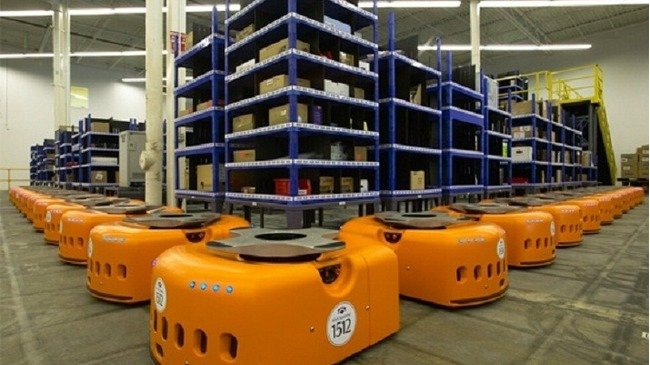
Robot developer Locus Robotics wants to market the successor to Amazon's Kiva robot. The order picker should become so user-friendly that warehouses will massively deploy the robot.
Locus Robots originates from Quiet Logistics. The latter used Kiva robots until 2012. When Kiva Systems was acquired by Amazon, Quiet Logistics had to look for another warehouse robot. It decided to develop its own robot with Locus Robotics, which will be even cheaper and more efficient than the Kiva robot.
Limitations of Kiva robot
Bruce Welty, co-founder of Locus Robotics states to IEEE Spectrum that it has learned lessons from the problems it encountered with the Kiva robot. "As you can imagine, the first version of something revolves around getting it working," he says. For instance, the Kiva robot was very expensive and heavy. Moreover, implementing it would be a lot of work. The fact that it needs to work safely with humans was also not taken into account when developing the Kiva. The Kiva worked with a separate infrastructure, while the new robot can be adapted to the existing infrastructure in a warehouse.
Navigation
The robot navigates using lidar (light detection and ranging, or laser imaging detection and ranging). The robot knows where objects are located in the warehouse, enabling it to drive straight to the correct spot. The robot waits there until the warehouse worker patrolling that area places the object onto it. The robot then moves on to the next object. This significantly reduces the number of kilometres that human warehouse workers have to walk.
Video: Mike Johnson, founder of Locus Robotics on the technology behind the new robot.
Editorial LogistiekProfs











