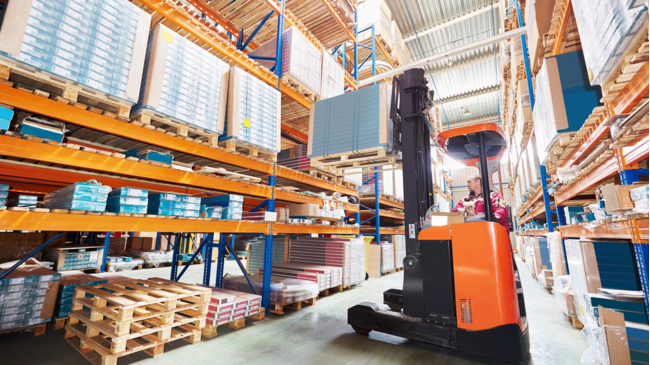
Safe equipment is a basic requirement for a safe warehouse. Safe equipment first and foremost means equipment that is in good condition and is inspected periodically. But how do you organise a periodic inspection that costs little and delivers a lot? Three practical tips.
The topic of warehouse safety was
autumn: during the presentation of the
new Healthy and Safe Working Code on 13 September and during the
Warehouse Day on 9 November. On both occasions, the focus was primarily on the
safety culture in warehouses and staff behaviour. And rightly so, because
these factors are crucial for a safe working environment but, at the same time,
also the most difficult to influence.
Whilst focusing on these ‘soft’ factors, we must
be careful not to lose sight of the ‘hard’ factors. Think,
, for example, the safety of equipment such as forklift trucks, warehouse trucks,
traction batteries and warehouse racking. Companies have a legal
obligation to provide their employees with safe equipment. This
means that companies must not only pay attention to safety
but must also ensure that the equipment remains safe.
In other words: companies must maintain the equipment properly and
inspect it periodically.
Good equipment is a ‘no-brainer’
In fact, ensuring that equipment is
well-maintained, regularly inspected and therefore safe equipment is a ‘no-brainer’. A
machine in good condition breaks down less often, lasts longer and
therefore delivers a higher return. What’s more, a machine in good working order means fewer
downtime in operations. Just try getting all your orders out on time
when a few crucial machines are forced to sit idle. And we haven’t even
costs of accidents.
How do you organise a regular inspection of your
equipment? Here are three practical tips.
Tip 1: Combine inspection and maintenance
Before any maintenance or inspection, a forklift or
warehouse truck must be temporarily taken out of service. Anyone who combines maintenance and
inspections together, you’ll need to take your machines out of service less often.
What’s more, a combined inspection and maintenance service saves a lot of time:
during routine maintenance, most items on the inspection checklist
are automatically covered, so an inspection takes very little extra time.
Naturally, the inspection costs are also considerably lower as a result.
Tip 2: Have your supplier inspect your equipment
The law does not specify whomust inspect the equipment. You
can do it yourself or hire an inspection body, but the question is who is
is best placed to assess the condition of the equipment. That is almost
always the supplier. They possess the necessary knowledge of the
equipment and has experience of wear and tear, damage and incidents involving other
customers. They are familiar with the equipment’s specifications at the time of delivery and can therefore
to what extent its current condition differs from that. They are familiar with the company’s
company, has access to the maintenance history and knows how the staff
handle their equipment. In short: the supplier is uniquely placed to assess
what is and is not responsible.
Tip 3: Choose a certified
inspection company
Anyonecan stick an inspection sticker on an approved
forklift truck, warehouse racking or traction battery. But what is that sticker
worth when an accident occurs and the SZW Inspectorate (the
former Labour Inspectorate) questions the condition of the machine?
Anyone who chooses BMWT-Keur is assured of an expert and objective inspection
in accordance with established guidelines, the results of which are set out in an inspection report
. A Panel of Experts ensures that the inspection remains professional
and is updated whenever technical developments or new insights
necessitate. In addition, the inspections are subject to random
to guarantee objectivity. Furthermore, the inspecting
companies undergo an annual audit by TÜV Rheinland. With BMWT-Keur, companies
can therefore demonstrate that they have fulfilled their legal obligations.
Equipment that is inspected at regular intervals is a basic requirement for
a safe warehouse, but of course this is not enough. Operators remain
required to check the condition of their forklift or warehouse truck every day before
they get on board. They must report any incidents so that, based on
the damage to the machine or the racking, it can be assessed whether it is
is safe to do so. Furthermore, the equipment is only one of three factors – alongside
people and the environment – that must be in order before a safe
working environment can be achieved. However, it is a factor on which companies
can easily take action on and achieve rapid results.
BMWT – the trade association representing suppliers of construction machinery, warehouse equipment, road construction machinery and transport equipment.











