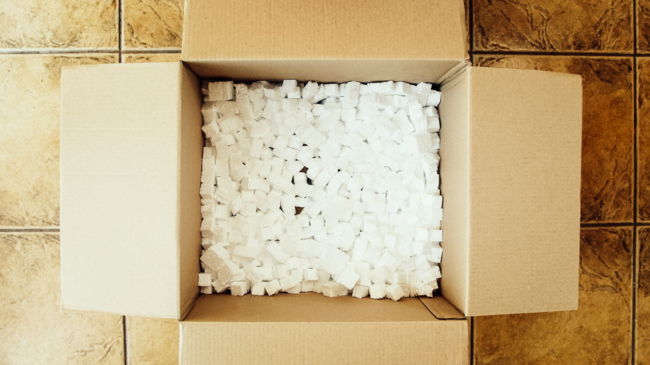
Companies often use too large shipping packages for their products. Thirty to 40 per cent of these packages consist of air, according to research by the Flemish Institute for Logistics (VIL). The oversized packages not only take up valuable space during transport, but also consist of too much packaging and padding material. As a result, over a third of shipping packages are less sustainable than they could be, not least because more delivery trips are needed to deliver the products.
Two US delivery companies already took the initiative to encourage their customers to pack less air. UPS and FedeX introduced a system that calculates the shipping price of a parcel based on size rather than weight: Dimensional Weight Pricing (DWP). Delivery costs are higher with larger parcels, making companies more critical of the size of their shipping packages. The Dimensional Weight Pricing (DWP) system has already been applied in the United States since 2015. Dutch companies exporting to America should therefore already take this new way of pricing into account. Three ways to pack less air are:
Range analysis
Packing less air starts with a range analysis. With a wide variety of products in many different formats, a wider range of boxes is often more economical than a narrower range. The packer then chooses the best fitting shipping packaging for each product, saving the company on costs for packaging and padding materials. A suitable box also further reduces damage during transport, as the product has less room to move in the box and is better secured.
Adapting primary packaging
Primary packaging can also play a role in the size of the shipping package. Sometimes primary packaging has awkward shapes, requiring a larger shipping package. A small adjustment in the primary packaging may already be enough to allow for a better-fitting shipping package. For example, by packing products in the primary packaging not on top of each other but side by side. A parcel can then be sent as letterbox mail instead of parcel post. You can go one step further by letting the primary packaging serve as shipping packaging. For example, by choosing a thicker type of corrugated board or a different closure, so that the primary packaging directly assumes the function of a shipping package. As a result, adjusting the primary packaging can even save on delivery costs in some cases.
Bespoke box
Companies can also choose to make a bespoke box for each shipment, also known as the Box-on-Demand. For large volumes and diversity of assortment, the customised box is an economical way to pack smarter. The machine makes a suitable box for each product or shipment, saving a company even more on packaging and padding materials and space in transport than with a wide box range.
In summary, then, 'smarter packaging' starts with an analysis of the assortment. Are there options for a wider box assortment or is a Box-on-Demand machine even more advantageous? Adjustments to primary packaging can additionally ensure more efficient shipping. As a result, products arrive at the customer in a more sustainable way and for lower costs.
Dirk Wijnveen - Business Unit Manager Food Retail & Industry at Bunzl











