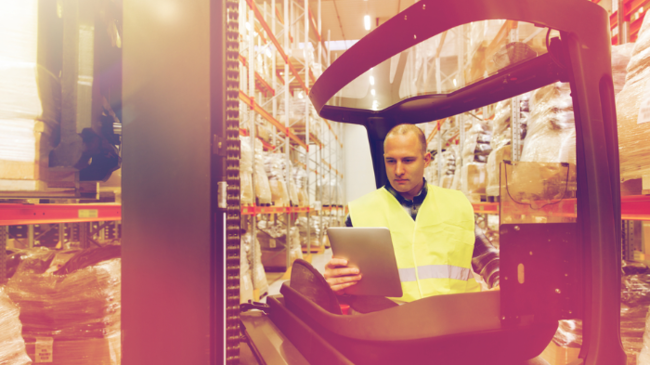
Forklift and warehouse trucks are providing more and more information
, making them better, more efficient and safer to operate. That is the
main conclusion of the press conference organised by Jungheinrich for the
international trade press. The most striking innovation was the
introduction of an indoor positioning system based on
Bluetooth technology.
Indoor positioning systems have been around for some time, but
they are usually based on RFID, laser or vision technology. According to Jungheinrich, these systems
are, according to Jungheinrich, quite expensive and therefore not
attractive. The German manufacturer of forklift and warehouse trucks is therefore introducing
a cheaper alternative based on Bluetooth. This technology, which was
developed by the Fraunhofer Institute, ‘beacons’ are positioned throughout the warehouse
‘beacons’ that continuously transmit a Bluetooth signal. When the forklift truck
comes within range of a beacon, its position can be
determined.
Heatmaps
Jungheinrich has currently developed four applications
for this positioning system. The first application is simply
than a search function. Not only drivers, but also mechanics sometimes waste
a lot of time looking for the right vehicle. The positioning system
shows exactly where each forklift is located. The second application is the recording
forklift movements within the warehouse. This produces ‘heatmaps’ that show
how drivers manoeuvre, which aisles are the busiest and which junctions
have become bottlenecks. By responding to this, one can prevent time wastage caused by
congestion and reduce the risk of accidents.
Jungheinrich highlights the third application as
‘zone guarding’. In the positioning system, specific forklift trucks can be
zones. As soon as one of the forklift trucks leaves its zone,
managers receive an alert. With speed zoning, the fourth and final
application, forklift truck drivers receive a warning on their terminal as soon as
they approach a hazardous situation. Consider, for example, a busy and
confused junction where a speed limit applies.
Two to four metres
And that’s not all. Jungheinrich
is working on new applications, in which the positioning system intervenes directly
in the vehicle’s control system. This makes it possible, for example, to
automatically reduce speed when the forklift enters an area with a high volume of pedestrians
. The system’s accuracy is between two and four metres.
This makes the system unsuitable for integration with the warehouse management
system and to record where a pallet has been
stored. Anyone wishing to do so will need to invest in a more expensive and more accurate
system.
As well as a positioning system, Jungheinrich has also
developed new modules for ISM Online. This fleet management system now offers more
options for denying staff access to certain machines – for example, those
for which they have not been trained. In addition, users can
schedule maintenance or periodic inspections themselves. Finally, the
upgraded battery management system provides more information on the condition of the
batteries.
Self-management
The benefits of a battery management system have
become increasingly apparent with the introduction of Li-ion batteries. Unlike
lead-acid batteries, these batteries continuously measure the voltage and temperature of
their own cells, which means they effectively manage themselves. They communicate with the
vehicle and the charger, resulting in an optimal charging curve, low
energy consumption and a long service life. Later this year, Jungheinrich will launch a
new generation of chargers that are connected to one another via the internet
. This offers opportunities for the smart deployment of the equipment, ensuring that no
peak loads occur when all batteries are connected to the charger
.
Battery hire
Jungheinrich is keen to accelerate the switch to
Li-ion batteries. Many companies are put off by the
initial costs, which are three times higher than those of traditional
lead-acid batteries. These companies can now hire Li-ion batteries at a
price that is proportionally much lower. The longer service life of this new
generation of batteries justifies this relatively low rental price. The old
lead-acid batteries can be traded in for a premium that depends on their
remaining service life.
Marcel te Lindert - journalist logistics & supply chain











