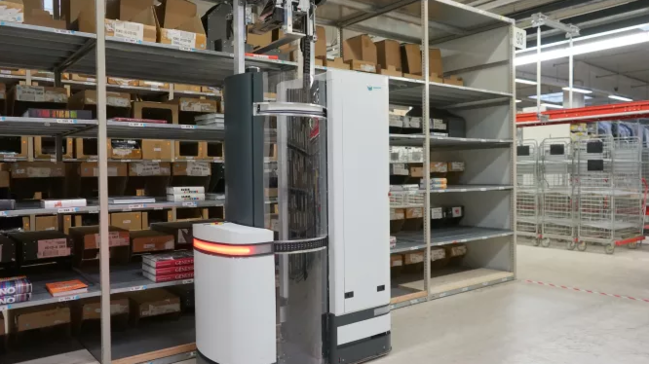
The robot is rapidly gaining ground. Both forklift suppliers and warehouse fitters are focusing on the market for mobile, self-driving machines. Advanced sensors should ensure that the robots avoid objects and people. But does that make them safe? The question remains whether employees in warehouses also know how to deal with robots in their environment.
A visit to trade fair LogiMAT earlier this month shows that the role of humans in the warehouse is getting smaller and smaller. Robots are demanding attention. But humans will not disappear completely for the time being. Most robots now being developed are intended to support rather than replace humans.
Today's robots can be distinguished into the following types:
Unmanned warehouse trucks: This seems to be the most basic form of robotisation: deploying warehouse trucks, but without a driver. They are used to transport pallets from A to B, but increasingly also to place pallets in racks or take them out again. The advantage is that they can always be operated manually again in an emergency. Because warehouse trucks are built in series, the costs are relatively low.
Semi-automatic warehouse trucks: these include narrow-aisle trucks or order-picking trucks with a driver, only the driver has to do less and less. Think of narrow-aisle trucks that find their own way to the next storage location after pressing a button. Or think of order-pick trucks that follow the order picker like a lap dog. Thanks to this form of automation, the driver can fully concentrate on his core task: order picking.
Specifically designed AGVs: automated guided vehicles designed specifically for this purpose. They can move totes or pallets from A to B. They can follow people closely and - at least in research centres - respond to gestures from employees. The developments in navigation technology are striking. Still popular is the use of lasers that respond to reflectors suspended at fixed points. But vision systems and grids of QR codes on the floor can also be used for navigation.
AGVs with robotic arms: These are AGVs that can not only drive to a pallet or bin location, but thanks to an arm with gripper can also pick items from that pallet or bin. They then stack those items in a shipping box or on another load carrier. The question is whether these robots can eventually replace all order pickers.
Flying robots: or drones, colloquiallyThey are mainly used for inventory counting for now, but research centres are also experimenting with drones picking and transporting items in warehouses. Linde showed a combination of a drone and an unmanned warehouse truck at LogiMAT. The drone serves to count stock, the warehouse truck to supply the flying machine with sufficient power.
Next to and between people
All these robots are designed to work alongside people. This is obviously the case with semi-automatic warehouse trucks, but it also applies, for example, to AGVs with robotic arms. Indeed, the new generation of robotic arms no longer needs to stand behind high fences to do the job. By presenting tasks as humans, robots know what action to perform. If the human gets too close, the robot arm will automatically stop.
For now, the main applications seem to be mainly aimed at supplementing manpower, not replacing it. There seems little chance, for example, that an AGV with a robotic arm will be deployed to collect all orders. More likely, this robot will be used for a certain basic volume, while additional manpower will be deployed at peak times. This also implies that soon people and robots will be moving through the aisles together.
Behaviour change
This leads to the question: what does this mean for safety in the warehouse? Robots are normally safe. AGVs and unmanned mega magazine trucks are equipped with sensors. As soon as those sensors detect something unexpected, the machine's speed drops to zero. The robot only restarts once there is no longer any danger in sight.
Less predictable is human behaviour in an environment with robots. An AGV typically has a slower speed than a lift or warehouse truck. This can lead to driver frustration and drivers pulling crazy antics to avoid delay. Alternatively, drivers may try to avoid the slow AGVs by using other aisles, with dire consequences.
Interacting with robots
Little is yet clear about the safety risks of robots in the warehouse. Those who are going to deploy robots in their warehouses will first have to take a critical look at their processes and set-up. Setting up the warehouse for robots can prevent forklift drivers and AGVs from colliding. This promotes efficiency. Companies should also pay specific attention to interaction with robots when training and educating employees. How safe are robots? And what rules of behaviour do we agree on when encountering robots on the floor? Whoever knows, may say.
Tom from BLOM - internal transport expert
Image: the robot deployed by logistics service provider Fiege in its warehouse. The robot is able to recognise and pick up items independently.











