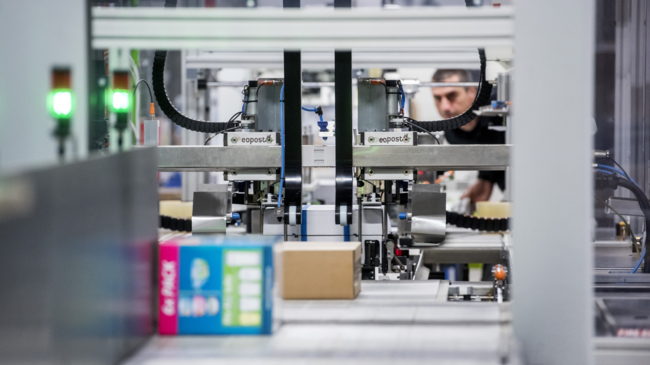
Returns are often seen as a necessary cost item for online shops. Yet returned orders can contribute to international success. Maurice Smedts, commercial director at fulfilment partner Ingram Micro Commerce & Fulfilment explains.
Ingram Micro - formerly active in the Netherlands as Docdata - handles the fulfilment of web giants such as Asos.com, Zalando and bol.com "Our returns logistics only really kick-started when we joined forces with Zalando," Smedts told Trade Day Logistics and E-commerce. The German retailer has a return period of no less than 100 days. Some 50 per cent of orders are returned within that period. This return logistics has provided Ingram Micro with the following insights in recent years:
- Open local return stations
"This is more attractive for consumers and more efficient for business. There are quite some costs in the chain, especially when each return has to be sent back to the central warehouse in Germany separately. From a local return point, you can return the products as bulk to the central warehouse."
- Returns vary by country
The return rate differs not only by product - electronics are returned less often than fashion, for example - but also by country. For instance, in Germany and other northern European countries, 45 to 60 per cent of online orders are returned, while in Spain and Italy the percentage is 15 to 25 per cent. In the United States, the percentage is even 15 to 20 per cent. "We had not taken this into account when setting up the local stations. There were just as many packing tables in Italy as in the Netherlands, for example, while they turned out to be completely unnecessary. "So when opening local return points, take the local consumer into account."
- Start from the Pareto principle
The Pareto principle (also known as the 80/20 rule) also applies to e-commerce, says Smedts. At one Ingram Micro customer, 6 per cent of the best-selling products accounted for 80 per cent of the total volume. What does that have to do with returns? "Those popular products naturally also came back to the local return stations. If you know those products will be sold again within a short time, why not redeliver them from the local return point?"
- Shipping from the local return point
Which brings Smedts to his last point: "67 per cent of products that were returned were sold again within five days. So good to keep your returns stored locally for a while. Chances are they will be gone again within five days. The products you don't sell within that period, still send them back to your central DC." Based on the Pareto principle, why not put your popular products in the local distribution centre by default? "It remains difficult to predict which products will score well in which region. You don't want to stock all kinds of products unnecessarily locally that end up not being bought."
Editorial LogistiekProfs
Image: Docdata Waalwijk











