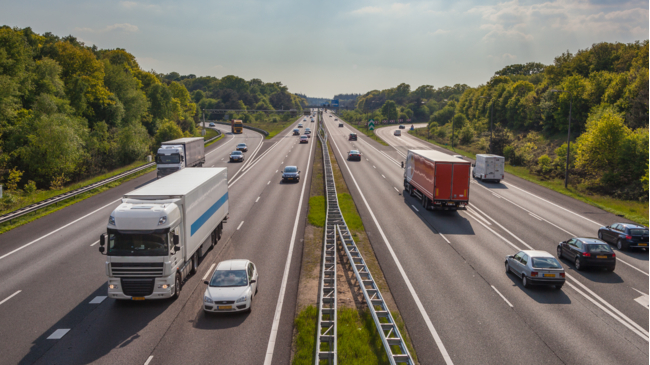
The Netherlands will get a kilometre charge on trucks 'as soon as possible'. That is in the coalition agreement of the new coalition parties. The plan is a thorn in the side of Transport and Logistics Netherlands.
The revenue from the kilometre charge will allow the motor vehicle tax on trucks to be reduced. "That sounds positive, but in the end they will take it away from us first," Arthur van Dijk, president of TLN, told BNR Nieuwsradio.
No improvement in mobility and climate
Road pricing is mentioned in the coalition agreement under the themes of 'mobility' and 'climate'. Van Dijk does not expect the charge to improve mobility. "There are 130,000 trucks in the Netherlands, but eight million cars, and we absolutely do not believe that mobility will increase then. Then you have to be with passenger cars."
The industry association does not expect the charge to have a positive effect on the climate either. The transport industry would drive 80 per cent of its kilometres on Euro 5 and 6, the cleanest engines currently available. "Euro 7 does not exist. So in that area, too, we don't expect it to have any effect." Van Dijk believes any kilometre charge should apply to all traffic. That way, the government could encourage people not to drive during rush hour.
Shift to smaller vehicles
"In addition, TLN already sees a growing trend towards goods transport with smaller trucks or vans. This category will soon not be covered by the kilometre charge. It is therefore expected that the shift from trucks to smaller vehicles will accelerate with the introduction of road pricing."
TLN is pleased with other plans in the coalition agreement, such as the investments in infrastructure (2 billion euros for three years and a structural 100 million), including investments in the A4, A7, A15 in the Randstad and the arterial roads to and from the south, east and north (A1, A2, A12, A28 and A58).
TLN wants to sit down with cabinet
TLN sees several positive things in the coalition agreement, but the overall balance tips to a negative assessment. The introduction of a kilometre charge as a mobility instrument only for trucks is unpalatable for the industry association. "It can only be factually explained as a hard burden increase, without anything positive in terms of congestion reduction in practice. In the area of sustainability, it is unclear how much the sector will see back from the burden increase." Van Dijk said he expects an invitation from the cabinet to discuss the burden increase in the near future.
Editorial LogistiekProfs











