The sharing economy has also made its appearance in logistics. Several start-ups are working hard on online platforms for sharing cargo space or storage space. The success of these platforms hinges on the ease with which member companies can share data. New standards make that easier. That is what the trade fair ICT & Logistiek will show from 28 to 30 November in the Jaarbeurs in Utrecht.
Most examples of the sharing economy in logistics relate to freight exchange. The fact is that trucks in the Netherlands are on average only half full or even less. Sharing all that empty freight space with the market should make it easier to fill up trucks. This not only increases the return per trip, but also leads to less freight traffic and less CO2 emissions. That is also the idea behind Synple, one of those new freight exchange platforms. "We want to automate and digitalise the cooperation between transport companies," says Roderick Rodenburg, founder of Synple.
Rodenburg realises that Synple is not the only player in this market. A global survey yielded some 100 freight-sharing platforms. The vast majority have the same effect: they lead to price erosion. "They bring supply and demand together in an UberFreight-like way. Shippers can offer their freights, to which transport companies can then bid. Whoever offers the lowest price gets the freight. This leads to ever falling prices in a market already characterised by low margins," Rodenburg argues.
Linking with TMS
Synple is trying to break that negative spiral. This platform focuses exclusively on transport companies. "About eighty per cent of freight on the road is transported on a contract basis. So the prices of those freights are already fixed. By enabling transport companies to cooperate with each other, they can further increase the load factor and thus efficiency," Rodenburg explains.
Transport companies can manually enter their trips on Synple. However, the real benefits only arise when they link their own transport management systems (TMS) to the platform. Once a match has then been made with the help of Synple's algorithms, information can be exchanged between the various TMS systems at the push of a button. In this way, it is also possible to closely monitor execution. When was the cargo picked up? When was it delivered?
On 1 September, the start-up announced that 1.1 million euros in funding had been raised from investors. So enthusiasm for Synple is high, including from the transport market. "In 2018, we hope to save 3 per cent in empty kilometres for our partners. But sharing cargo space through a platform is not a given. Whether a collaboration is successful depends first and foremost on the people involved, not on smart algorithms."
Sharing storage space
Unlike cargo space, storage space is still a relatively unexplored area within the sharing economy. Stockspots is trying to break that. Co-founder Remko Been: "We not only bring supply and demand together, but facilitate the whole process. Companies with an abundance of stock looking for temporary extra storage space sign a contract with us. They can then use our platform to see how much stock is in the external location. They can enter orders and monitor their follow-up online."
According to Been, if companies have distributed their stock across multiple remote warehouses, Stockspots offers even more value. "Stockspots offers transparency. Through one platform, companies have insight into all their external stock points. They don't have to make agreements with different logistics service providers about systems and data exchange. Because companies need to contract with only one party, it becomes easier to create new stock points. Think of shippers who want to locate their stock closer to customers."
One, two or three euro signs
With Stockspots too, the value of the platform increases when data does not have to be manually entered every time, but is exchanged digitally. This is at least true for storage providers, who need to provide insight into stock levels and order status. "They can link their own warehouse management system (WMS) to Stockspots, but also use the WMS functionality in our platform. Clients can also link their system so they can easily forward orders. But it is also possible to upload an Excel file with orders," says Been.
Stockspots officially launched on 2 October. Currently, the platform offers almost 450,000 square metres of storage space, spread over more than 60 locations. By the end of 2017, that number should grow to 150 locations both at home and abroad. Companies like Kloosterboer, Partner Logistics, Leen Menken, Mepavex, Koopman and Vos Logistics use the platform. Been: "The unpredictability in the chain is increasing, partly due to e-commerce. In addition, many companies are struggling with seasonal patterns. As a result, an estimated ten to twenty per cent of stock is available for external storage. Stockspots can accommodate that peak capacity."
Uniform agreements
The success of all sharing economy initiatives hinges on the ease with which participants can share data. Standards to facilitate data sharing are currently being worked hard on in various areas. One example is iSHARE, an initiative stemming from the innovation programme of the Top Sector Logistics. The aim of iSHARE is to create uniform agreements for identification, authentication and authorisation, which from 2018 will enable everyone in the logistics sector to share data with each other.
Project leader Mariane ter Veen makes the comparison with a credit card or iDeal. "Thanks to the uniform arrangements made by Visacard or Mastercard, a hotel or restaurant can be confident that the payment will be made correctly. Thanks to iDeal, a webshop like Bol.com does not have to make agreements with every bank about online payments. In the logistics sector, iSHARE provides agreements that allow everyone to share data in a uniform, simple and controlled way."
Relying on data
Crucial in iSHARE is that the owner of the data decides what happens to it. It decides which data can and cannot be shared and who can and cannot receive it. As an example, Ter Veen mentions inbound transport at distribution centres. "Usually, these distribution centres have no idea when a truck arrives. With iSHARE, a supplier can give its transporter the right to automatically share data about the expected arrival time with the distribution centre. If the transporter decides to hire a charter, it can "delegate" that right. iSHARE thus makes it possible to share data between parties who do not know each other at all. Thanks to the agreements made, the distribution centre can still trust that that data is actually about the supplier's cargo."
Last summer, iSHARE presented the beta version developed in cooperation with 12 co-creation partners. Work is currently underway to further refine the arrangement system, which will be finalised in early 2018. Then everyone can start working with it. "iSHARE is not a platform, not a blockchain and does not determine which data should be shared. That is up to the sector itself. We only ensure that everyone learns to speak the same language," Ter Veen states.
OpenTripModel
Unlike iSHARE, the industry is also working on standards defining which data should be shared in which way. One example is the OpenTripModel, developed by Simacan as part of the Talking Traffic project. This is basically a message set that should make it easier to exchange data on trips, routes and vehicles between logistics systems and traffic management systems, such as traffic lights and matrix signs above motorways. Among other things, this should promote traffic flow and improve real-time planning for logistics providers. The OpenTripModel was embraced this autumn by the Ministry of Infrastructure & the Environment and industry associations TLN and evofenedex. They established the Uniform Transport Code Foundation, which will further develop and manage the model.
e-CMR platform
Another example of data sharing in the chain is the e-CMR platform of TransFollow, one of iSHARE's co-creation partners. The e-CMR will replace the paper CMR, but brings with it many more possibilities. "Actually, the e-CMR is the connecting link in the logistics chain. The e-CMR creates clarity about cargoes, for example about who has now signed for the transfer of goods between shipper and transport company or between carrier and charter," explains René Bruijne, general director of TransFollow. "In addition, the e-CMR is now also used to record the amount of packaging taken back. Carriers and receivers can import relevant data from the e-CMR platform on expected arrival times into their TMS or WMS, so they can use better, up-to-date data when planning."
The e-CMR has now been embraced by Brussels and the international transport umbrella organisation IRU, greatly accelerating its adoption. In Spain, France and the Netherlands, the replacement for the paper CMR is already in use, with Belgium and Luxembourg to follow this year. In 2018, the list will be expanded to include countries such as Poland, the Czech Republic, Greece and Turkey. "The big missing link at the moment is Germany. That has everything to do with the diligence with which our eastern neighbours take up this kind of business. Germany is expected to fully accept e-CMR in late 2018 or early 2019. In the UK, e-CMR is really still a long way off as the Brexit is a priority there," Bruijne explains.
 Mariane ter Veen(r)_FK__02U0381.jpg)
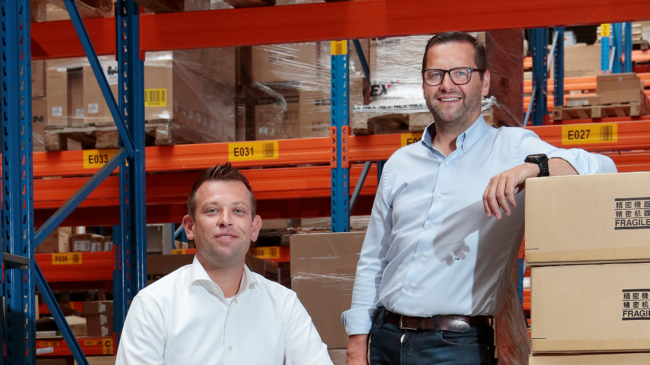
René Bruijne and Marianne ter Veen
Blockchain
Meanwhile, the e-CMR plays a crucial role in a blockchain project. Because the e-CMR can establish irrefutable proof-of-delivery, TU-Delft has taken that as the starting point for a new concept for supply chain finance. Together with ABN-AMRO and TransFollow, an operational blockchain has been set up where the carrier's invoice can be financed directly via a factoring marketplace after delivery based on the e-CMR. This allows the carrier to access its money sooner.
But blockchain offers many more possibilities in the supply chain, Bruijne explains. "Think, for example, of temperature registration and traceability of raw materials. Here we are really still a the beginning of introducing a new technology that will take transparency to the next level."
ICT & Logistiek will take place simultaneously with Logistica 2017 this year. Register for ICT & Logistica here, register for Logistica 2017 here. Your badge will give you access to both exhibitions.











