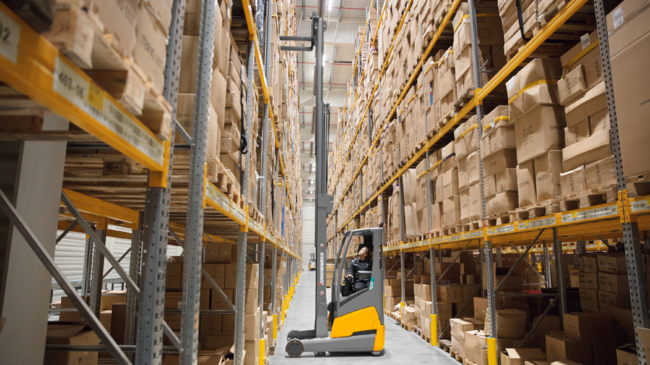
Jungheinrich is introducing the first ever reach truck with a fixed, permanent lithium-ion battery at LogiMAT. This provides an extremely compact reach truck with more all-round visibility than its predecessors. In addition, Jungheinrich will launch a miniload crane for the first time at the Stuttgart trade fair.
Lithium-ion batteries are smaller and lighter than traditional lead-acid batteries. In addition, they require less maintenance; refilling with water, for example, is no longer necessary. Because lithium-ion batteries can be charged faster and with more control, they also no longer need to be changed for shift use. By taking all these features into optimum consideration, Jungheinrich has succeeded in designing a completely new reach truck: the ETV 216i.
The new reach truck is more compact than its predecessors. Whereas in traditional reach trucks the lead-acid battery is placed between the driver and the mast as standard, in the ETV 216i the lithium-ion battery is partly located under the driver's seat. This made the machine 70 millimetres shorter. "Perhaps the truck could have been even shorter, but we also need space for the additional 500-kilogram counterweight. In addition, upward visibility when working at height decreases if we make the truck even shorter," says one of the members of Jungheinrich's design team.
Better visibility
The new truck also offers better forward visibility now that it is no longer obstructed by the battery compartment. This enables drivers to manoeuvre better and more safely, for example when approaching warehouse racks. Drivers also have more space in the new truck. As both seat, backrest, armrest and steering wheel are fully adjustable, Jungheinrich says the ETV 216i is suitable for drivers between 1.50 and 2.10 metres tall. The new reach truck comes standard with a glass panoramic roof for optimal upward visibility. "But for dusty environments, we also offer a steel roof without glass," says Jungheinrich.
The new machine is not only more compact and safer, but also faster. As lift speed has been increased, productivity increases by five per cent. Loads weighing up to 1,600 kilograms can be put away up to a height of 10.7 metres with the ETV 216i. In June, Jungheinrich will deliver the first trucks to customers. In the meantime, designers are also working to fully adapt the design of other trucks to the new generation of lithium-ion batteries.
Miniload crane
At the LogiMAT, Jungheinrich surprises with another innovation: a miniload crane. This is Jungheinrich's very first fully in-house developed warehouse crane, made possible by its acquisition of warehouse crane manufacturer MIAS in 2015. With this miniload crane too, Jungheinrich is trying to be one step ahead of the competition. With a speed of over six metres per second and high acceleration, it claims the STC 2B1A is the fastest miniload crane currently available.
The new miniload crane is not only fast, but also economical. The energy released when braking the machine, for example, is stored in supercaps for reuse. The modular, lightweight construction of the mast makes it possible to build miniload warehouses with a height of 25 metres. With a patented drive system and rail construction, Jungheinrich says storage density has also been increased. The new miniload cranes will be available by the end of 2018.











