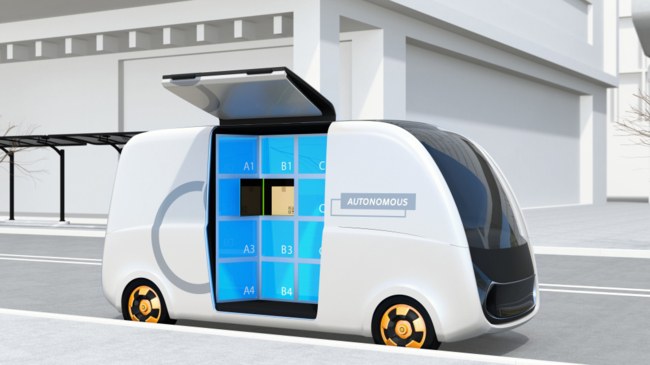
The technological possibilities for self-driving vehicles look promising. However, a large-scale deployment of the vehicles remains out in the coming years. Only through intensive cooperation can self-driving transport become a success in practice.
So concludes innovation platform VIL following the ALEES project. Together with seven companies, including bpost and DHL, and the city of Mechelen, the organisation investigated the possibilities that self-driving vehicles can offer for distribution in city centres.
First test of self-driving transport

A first test of a self-driving vehicle from French company Easymile was conducted in the centre of Mechelen at the end of May. The vehicle covered the route autonomously, making stops at local entrepreneurs to deliver goods.
Consolidated deliveries
VIL concludes that self-driving units offer a lot of advantages for a city. The cars are compact, quiet, emission-free and safe. They handle flexible route schedules and better loading, making deliveries more efficient. More consolidated deliveries also reduce traffic and improve the livability of city centres.
Cooperation needed for maximum loading
The ideal scenario would be a hyper-connected network, in which autonomous vehicles are loaded to the maximum. For this, city hubs are desirable: small distribution centres on the outskirts of cities. Local retailers and entrepreneurs store their inbound volumes here. Autonomous vehicles can then be used to bring the products to the city centre. Micro warehouses are needed in the city centre, serving as storage points for local distribution.
To realise the above scenario, however, volume, and hence cooperation, is needed, VIL concludes. "Flanders does not have world cities, so cooperation will be needed. This cooperation between different parties is crucial, but immediately also the most difficult task," says VIL project leader Kris Neyens.
Faster implementation through testing
Together with logistics service providers, cities and governments, VIL will test the technology for a long time. The platform stresses the importance of a coordinated approach to testing the vehicles. "The mutual injection of knowledge and experience from industry and the logistics sector should strengthen our governments with concrete expertise. This will ultimately lead to faster implementation of autonomous urban logistics vehicles and the associated benefits," VIL concludes.











