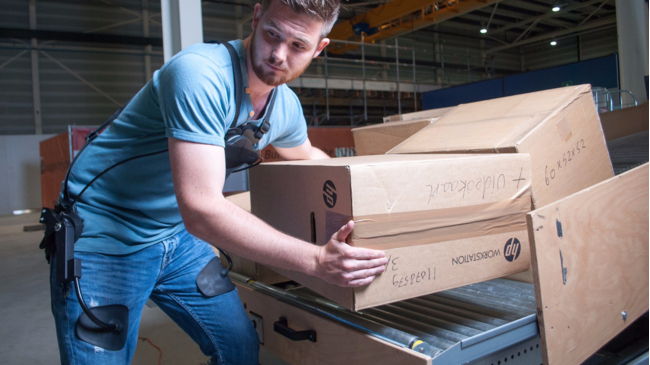
Exoskeletons or robotic suits have potential in logistics, but are not yet sufficiently developed for wide deployment in the sector. The suits appear to be less suitable for dynamic tasks, for example.
That is the conclusion from the project 'Exoskeletons for logistics', which Innovation Platform (VIL) carried out with 14 companies. Exoskeletons can boost the human body. The suits are used in the health sector, for example, as an aid to rehabilitation. VIL investigated whether the technology could also provide support in logistics operations. Especially for taxing manual tasks, such as order picking, packing, stacking, loading and unloading, an exoskeleton could be a possible aid.
French company Geodis has been using exoskeletons in its warehouse in Venlo since 2017. The suits should support the lower backs of employees who sometimes lift up to 4,000 kilos a day.
Passive exoskeleton
VIL focused its research on the passive exoskeleton. This redistributes human force, reducing the strain on the body at weak points. The active exoskeleton is motor-driven and uses energy from outside. However, this variant did not yet appear to be available on the European market.
Suitable for static tasks
Field tests were conducted in the warehouses of four companies: Colruyt, Danone, Mainfreight and Gates Distribution Center. The experiences varied widely. Some users did find the suits suitable as an aid. This mainly concerned workers performing static tasks, such as working for long periods in one particular position on a belt. Users reported better posture and less strain on the back and shoulders. Passive exoskeletons were found to be less suitable for dynamic tasks in logistics. The suit was then considered uncomfortable due to friction, impact and restricted movement.
Technology in development
"Based on practical tests, we saw that, among other things, the comfort of the exoskeleton had a major impact on user satisfaction," says project leader Luc Pleysier. "However, we dare to cautiously state that the user would evaluate it more positively with a better match between (partial) task and exoskeleton, a longer habituation period, better follow-up of adjustments and correct use. Moreover, the technology is still evolving and through cooperation between technology developers and the logistics sector, more targeted applications will be realisable in the future."











