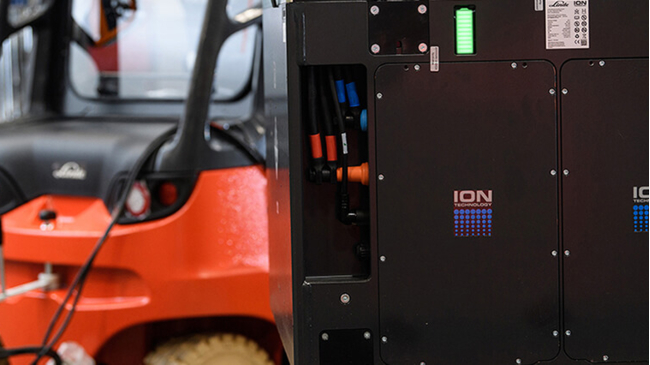
Linde Material Handling has expanded its lithium-ion battery portfolio, supplementing the existing battery versions with a larger variant designed for high-energy use.
Lithium-ion batteries offer advantages over conventional lead-acid batteries, but come with relatively high purchase costs. "As these costs increase with increasing capacity, batteries must be precisely tailored to the customer's needs," says Christoph Englert, product manager for energy strategy and solutions at Linde Material Handling. The intralogistics specialist is therefore aiming for a greater variety of battery capacities.
For lift trucks in the 2 to 3.5-tonne lifting range (Linde E20 to E35), the existing battery versions of 24.1 kWh and 60.3 kWh have been complemented by a larger variant with a capacity of 84.6 kWh. This is designed for high-energy consumption applications, for example in the paper and beverage industry. Furthermore, a new medium-capacity battery has been added for industrial lift trucks in the lifting capacity range between 3.5 and 5 tonnes. In that range, Linde Material Handling is closing the gap between the smaller battery (36.2 kWh) and the larger battery (118.4 kWh) with a 66.3kWh battery. For 6-8-tonne forklifts, a second battery size of 64.7 kWh is now available to complement the existing 118.4kWh battery.
"If a forklift needs a large amount of energy, for example to transport heavy loads, the battery must be matched accordingly. The same applies if the trucks are used intensively continuously for many hours in multi-shift operation and the operators have little or no possibility of charging their forklifts for a longer period," Englert explains. However, according to Englert, the situation is different when the forklift can be charged several times during a shift. In that case, a smaller battery would still be sufficient to continuously supply the forklift with the required energy.











