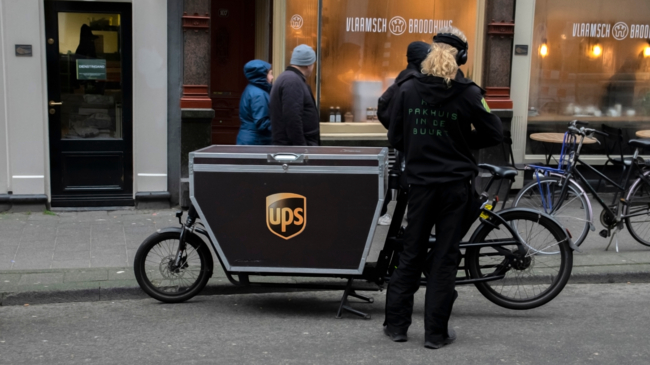
Major challenges await us in the field of urban logistics. The volume of transport is growing, while the environmental impact must be reduced due to the Climate Agreement. Meanwhile, customer requirements are changing and the number of logistics concepts to choose from is greater than ever. ShoppingTommorow's expert group City Distribution prepares retailers, municipalities and carriers for the city logistics of the future in its bluepaper.
Both consumers and businesses are increasingly ordering online. Returns are increasing and the sharing economy is creating more shipments between consumers. As borders are increasingly blurred, the expert group avoids terms such as b2b, cb2 and c2c. Rather, it talks about l2l logistics: transporting shipments from location to location.
In the increasingly crowded inner cities, l2l shipments must be done in a smart, bundled, safe and sustainable way, argues the expert group after a year of research led by TLN, Prologis and the University of Groningen. A profitable l2l concept requires a flexible and intelligent logistics system that links efficient bundling of goods flows with optimal deployment of people and means of transport. That system must also take into account the space available for storage and transport. In addition, further cooperation between the various stakeholders is necessary for an appropriate logistics ecosystem in the city of the future.
City Distribution provides the following tips to different stakeholders in the bluepaper:
The providers - (web) retailers
Webshops have to offer customers the choice between home delivery and pick-up. They should also provide insight into the environmental impact of a particular order. "Look for opportunities for outsourcing and bundling when it comes to small shipments," said the expert group.
Professional recipients - retailers, offices
Business recipients should provide opportunities to receive goods early in the morning (at the beginning of window time) and think about joint purchasing.
Logistics - shippers and carriers
Strengthen cooperation, both horizontally and vertically, advises the expert group. "Share data to combine shipments smarter. Consider multilabel parcel lockers and collection points." Creating a good alternative for retailers allows them to get rid of delivery vans and small shipments can be bundled across town. Logistics service providers should also offer attractive work for employees and prepare them for the future with training.
Government
Governments should adopt a clear policy with clear boundaries and a date for the entry into force of zero-emission zones. When developing regulations for urban logistics, they should involve industry. "Get to work on data sharing to allow transporters to move smoother and smarter through cities. Consider wider opportunities for silent electric vehicles to deliver at night and at the 'day edges'," the expert group concludes.
Read the full bluepaper here.











