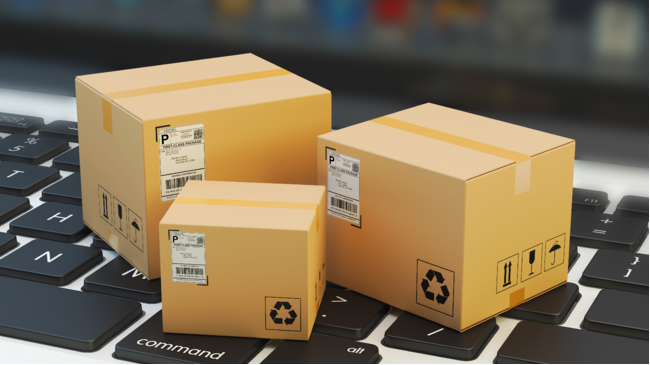
Although e-commerce has of course been around for much longer than 2015, this was the year that online shopping got bigger than ever. This was in contrast to physical retail, which increasingly struggled to resist.
E-commerce rose to a new level in this year. Many online retailers have implemented or are in the process of implementing an omnichannel strategy. ICT integration is the biggest challenge in the rollout. More than 60 per cent offer a click & collect delivery model, according to a market survey by software provider Descartes among 57 retail organisations in the Benelux.
In total, Europeans spent 447 billion euros on online purchases in 2015, up 15 per cent from 2014. In 2016 and 2017, even greater growth is expected by research firm GfK.
Initiatives
Many efforts are being made to keep developing the e-commerce industry. For instance, opportunities to order food items online increased and pick-up points shot up like mushrooms. Delivery of the parcel to the door was also made easier: the neighbour driving around his neighbourhood for an extra penny, Bruna making it possible to pick up parcels 24/7 at lockers, the many bicycle couriers reducing environmental impact and Albert Heijn partnering with Bol.com as a pick-up point.
Package delivery speed is another point where e-tailers tried to outdo each other in 2015. 'Ordered before 8pm, delivered the next day' was shifted to: 'Ordered by 11am, delivered next day'.
FoodJumbo started delivering groceries to your home in 2015, while Albert Heijn has been doing so for some time. The latter expanded this service to include real-time Track & Trace, allowing customers to keep an eye on their order via text message, but the biggest surprise was delivery services like Picnic, which expects to expand its delivery area to other major cities in 2016. So far, the service is only available in Amersfoort and Leusden.
Volatile situation
The growth of e-commerce does not only bring benefits to the market. When it comes to the last mile, there are still plenty of challenges. Distribution models need to be redesigned. In September, Alvar Piepers, marketing manager of Paazl, spoke of a "dynamic and capricious" logistics situation at the Emerce Efulfillment event. "Because online shops and logistics providers are so good at last-minute delivery, consumers are going to make massive use of it. That growth will continue like that in a very short time." But that is not without consequences, according to Piepers. "The walls of a distribution centre are not made of rubber. The situation is becoming almost untenable for carriers."
Packaging
This development is also a step in the right direction for the packaging industry. The cardboard industry in particular is taking full advantage: Every year, about 18 million tonnes of cardboard are needed to provide packaging for all orders, in the coming years this market will increase by two per cent. That is equivalent to 385,000 tonnes of cardboard.
Yet it turns out that packaging is also a big issue in e-commerce. E-commerce requires customised packaging, not only to prevent damage, but also to drastically reduce the number of kilometres driven. Logistics journalist Marcel te Lindert called for a reorganisation of packaging in e-commerce. "Products often end up in a shipping box that is far too large, which therefore has to be manually filled with air bags or crumpled paper. Closing the box is also still far too often done manually."
2016
What 2016 will bring us in terms of e-commerce is so far only guesswork. But with a brilliant year like 2015 behind us, we can at least hope that the market will continue to develop and that there are great initiatives and technologies coming up that can solve the issues surrounding e-commerce.
Editorial LogistiekProfsThis article also appeared on Packagingprofs.co.uk











