Will our DCs be fully automated in a few years, or will humans continue to be needed for some operations? Despite advanced automation, players such as Wehkamp, Albert Heijn, Montapacking and Blokker are still betting on human capital. "A human sees that products are underneath each other, a robot does not yet," he says.
Speakers on the Warehouse Insight stage seem to agree on one thing: automation delivers efficiency. Both Wehkamp and Albert Heijn and Montapacking are embracing a far-reaching combination of hardware and software in their DCs to optimise processes. At the end of this year, for example, Albert Heijn will move into a distribution centre in Zaandam in which almost its entire range of perishables will be processed mechanically, Marjon de Koning, logistics director at Albert Heijn told the Warehouse Insight stage. Thanks to a storepick solution from Vanderlande, the work for warehouse staff is lightened and the process is more efficient. De Koning: "With this distribution centre, Albert Heijn is ready for growth."
Wehkamp is also working on a new location. Almost four years ago, the online shop opened a heavily automated distribution centre in Zwolle. Since then, Wehkamp has grown so fast that its ceiling is already in sight. A new warehouse is therefore springing up next to the existing premises, in which the retailer is once again working with an automated warehouse system from warehouse specialist Knapp.
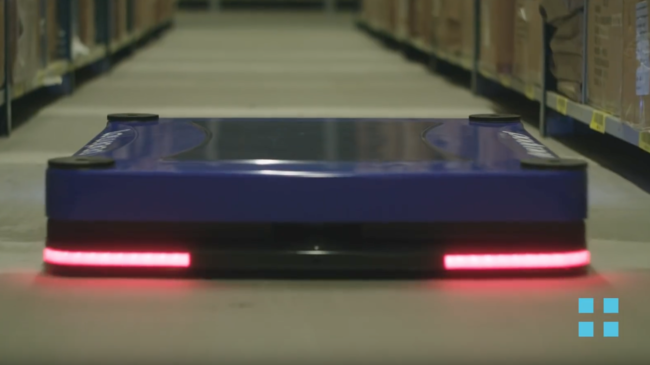
E-fulfilment service provider Montapacking opted for an 'Amazon-like operation' at its site. In the warehouse, humans and robots work side by side using a goods-to-man system. "If you can reduce the daily kilometres of warehouse workers with robots from ten to one kilometre, you are very happy," says managing director Edwin van der Ham.
Flexibility
Still, Van der Ham sees little in full automation of his processes (for now). "Robots are more efficient, but people are more flexible. To cope with peaks, we need flexibility." The director cites Black Friday as an example. In 2017, the US shopping day was still a relatively unknown phenomenon in the Netherlands. A few affiliated webshops threw their products on sale. This attracted consumers in large numbers. "At 9am, our WMS indicated that it was extremely busy. We overruled that manually at first; we thought something was going wrong. The Black Friday phenomenon was on the news and by 11am, many of our customers had started spontaneous promotions. That day, all our order records were broken. Thanks to the deployment of a lot of extra staff, we were able to cope with that rush. Not necessarily in the most efficient way, but very flexible. By the end of the day, all orders were out the door."
Warehouses fully automated in 5-10 years
That human handling still comes in handy, visitors to Warehouse Insight agree with Van der Ham. When asked "When will warehouses be fully automated?", a majority of the audience replied that it will take another five to 10 years. Eelco Spaans, Head of Supply Chain Solutions at Wehkamp, sees order picking as the biggest stumbling block. "That remains difficult to automate, especially with an assortment of more than 450,000 items. A human sees that products are underneath each other, a robot does not yet. It will be a few years before robots are ready. We are busy developing with Knapp, though."
Human intervention will also continue to be needed at the Albert Heijn, albeit to a limited extent. One-third fewer staff walk around the premises than in other warehouses, although the number of technical staff has increased. "Some perishable products do not yet lend themselves to full automation, for which we have built in manual processes. These are added at container level or per tray. Ultimately, we want to automate between 95 and 100 per cent." A third fewer staff walk around the premises than in other warehouses, although the number of technical staff has increased.
'Knowing well what you want to achieve with automation'
At Blokker, they are cautious about robotisation for now Blokker's existing distribution centre was in need of an upgrade. In one month, the retailer will be running on a completely renovated omnichannel centre that features a shuttle aisle with over 4,000 storage units, 65 pick-to-light carts and a put-to-wall solution from system integrator Inther. The building still has little in the way of robotisation. Roel Megens, site manager of the Geldermalsen premises, says: "We decided it was wiser to integrate online and offline in one DC. The WMS has been upgraded, but we are not doing much about robotisation at the moment. We are doing a thorough repositioning and keeping the options open. You don't automate just like that. You have to know very well what you ultimately want to achieve with it."

The layout of the Blokker DC in Geldermalsen
The products Blokker sells are also difficult to fit into a fully automated process. "It's a huge job to get the dimensions of all those products into a system. You need a completely different outer box for a bucket than for a beach chair. Then you also have to then teach that system that two buckets fit together while two chairs cannot."
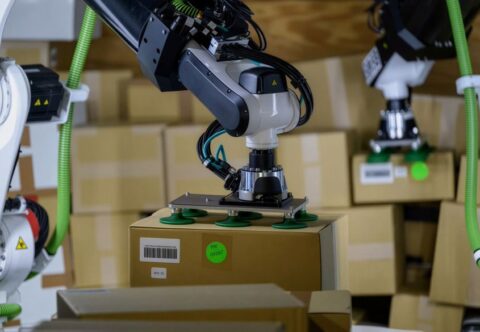
Image top: Montapacking's cobot