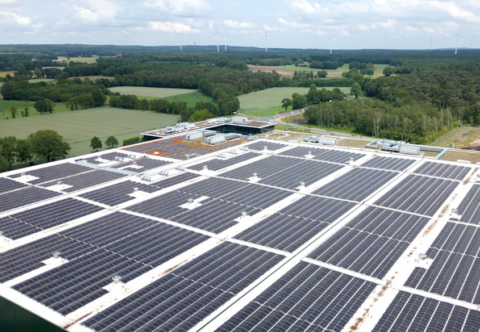
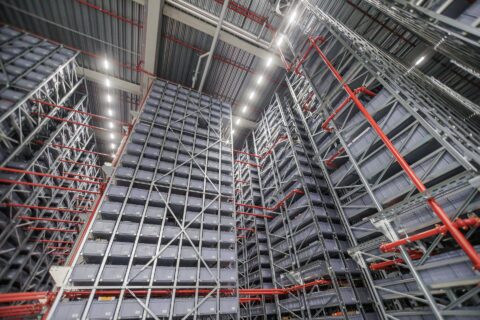
Anyone driving along the A58 motorway couldn't have missed it: The Tube, the new, imposing distribution centre for Rhenus Logistics. LogistiekProfs got a sneak preview of the most sustainable DC in the world.
Never before, anywhere in the world, has a distribution centre achieved a BREEAM score of 98.48 per cent. This is what The Tube, the new home for Rhenus Logistics is now changing. The DC owes this world performance and the accompanying BREEAM Outstanding certificate to numerous sustainable solutions as well as smart gadgets. Because even when it comes to sustainability, 'measuring is knowing'.
Brownfield development
New Logic III - as the DC is officially called - was built by Heembouw, commissioned by Dokvast. The impressive, futuristic design comes from Heembouw's in-house architect Habeon Architects. From the building, Rhenus Logistics will handle logistics for various customers from what the service provider itself calls the health-tech sector. A strongly growing market and one of the spearheads for Rhenus.
The Tube offers 40,000 square metres of warehouse floor, 18,000 square metres of mezzanine floor (where mainly value added services will be carried out) and 4,400 square metres of office space. The total plot size is 75,000 square metres.
This concerns an existing piece of land. In other words: New Logic III is a so-called brownfield development. That obviously contributes to sustainability, but that alone will never make you the world's most sustainable DC. There is therefore much more.
Salt on all sustainability slags
The DC, for instance, is completely electric; even the heating system no longer uses gas. Special glass was used for the offices in connection with heat permeability, the car park has plenty of charging points for electric cars and attention is paid to greenery. Both outside and inside.
The required energy is collected via solar panels and a grey-water system is used. This means rainwater is used for e.g. flushing the toilets.
The final logistics layout also contributes to the high sustainability score. At The Tube, for instance, Rhenus Logistics will be working with an AutoStore system from Swisslog. Thanks to this compact storage and order picking system, 25 per cent less space was sufficient.
Energy-efficient light
Furthermore, both the offices and the warehouse make great use of daylight. Like the working climate, daylight largely determines employees' well-being. And that is increasingly important when it comes to sustainability, especially in the logistics hotspot where New Logic III is located.
But energy-efficient solutions have also been chosen for the other lighting. For instance, only LEDlighting is used, with Trilux realising a digital, scalable lighting infrastructure that offers users plenty of benefits and maximum flexibility.
At Dokvast's request and in consultation with Rhenus Logistics, for instance, a deliberate decision was made to use overcapacity, so that lighting requirements can be adjusted quickly and easily to any changing operating conditions. Light heat varies to provide employees with optimum well-being at any time of day.
Smart sensors
The DC also offers flexibility thanks to over 1,000 sensors installed by Docc Control. The sensors measure everything from water consumption in the toilet to the number of times a dock door opens and closes or how often a certain route is chosen. Of course, the collected data still needs to be interpreted correctly. To do this, the sensors are in contact with an intuitive and user-friendly platform via the Internet of Things. This platform keeps users constantly informed via tickets about issues important to them, such as malfunctions, problems or recurring servicing and inspections.
Preventive maintenance can thus be planned optimally and cost-effectively and - at least as important for the most sustainable DC worldwide - energy consumption can be kept to an absolute minimum.