Supply chains today have to be not only reliable and efficient, but also fast and flexible. That can't all be done at the same time. Industry companies will have to make choices. On 7 and 8 November, the trade fair ICT & Logistiek will show smart ICT solutions for that purpose. Prof Jack van der Veen of Nyenrode Business University will speak during the trade fair about the importance of strategy and innovation. "I am a big fan of sales & operations planning, but too often it is nothing more than a piece of software for sharing information."
For a long time, supply chain professionals in industry only had to focus on two aspects: reliability and cost. Companies needed to deliver their products 'on time, in full' and to do so as efficiently as possible. The limits of what is possible are now coming into view, along with unwanted side effects such as suppliers stripped to the bone and short-term strangulation contracts with service providers.
At the same time, it is increasingly apparent that a reliable and efficient supply chain is not enough. Social, political and economic developments such as the rise of the mobile internet generation, the new trade barriers between the United States and China and the ongoing uncertainty surrounding the Brexit require supply chains that are also fast and flexible. Companies need to be able to respond quickly to customer demand and design their supply chains accordingly.
Importance of strategy
The current times force companies to think more carefully about their strategy, says Prof Jack van der Veen. "Reliable, efficient, fast and flexible: you can't do it all at once. Companies not only have to professionalise, but also make choices and innovate. For a very long time, the emphasis was on the first aspect; little came of the last two aspects," states the professor of supply chain management at Nyenrode Business University, who is conducting the Masterclass Supply Chain Strategy during ICT&Logistics.
Strategy is about making choices, argues Van der Veen. "We cannot simultaneously serve every customer optimally and operate hyperefficiently. Those are two aspects that are at odds with each other. We have to make trade-offs. Which customer are we going to serve and which not? Or should we make an extra effort in the supply chain to serve that other customer as well, even at the expense of efficiency? Do we choose a high service level or low costs?"
Sales & Operations Planning
Sales & Operations Planning (S&OP) is the strategic process in which the commercial and manufacturing sides of the business make these trade-offs together. Many companies are currently doing S&OP. Van der Veen thinks this is a good thing. "I am a big S&OP fan. In fact, S&OP is nothing but internal chain cooperation, cooperation between marketing, sales, production and supply chain. Its importance is obvious."
At the same time, Van der Veen is critical. "I see too often that S&OP is seen as implementing a software package to share information. Fine, but S&OP is much more than information sharing. The goal is to make optimal decisions. This requires alignment and collaboration. Too often, sales leads and supply chain suffers."
Digitalisation of supply chain
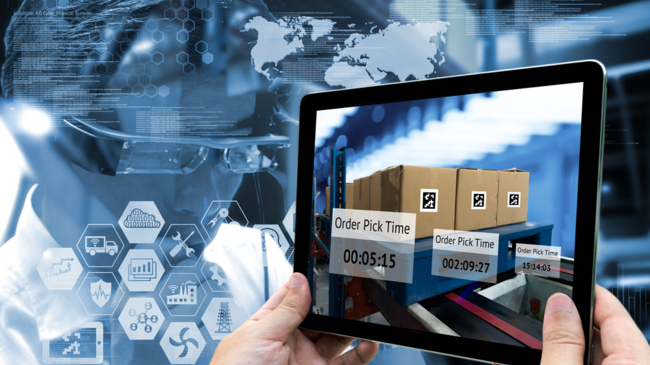
ICT is not an end in itself, but digitisation of supply chains is necessary. Digitalisation means optimisation of information flows, which can have a positive impact on the flow of goods. In turn, a better flow of goods leads to more customer value. And according to Van der Veen, that is exactly what supply chains are all about, increasing customer value. "Innovation is a task of supply chain. But in the short term, innovation often leads to process disruption and thus inefficiency. That makes innovation difficult in supply chains where costs are calculated to three decimal places."
Science offers incredibly good algorithms waiting to be applied. "In the field of operations research, work on algorithms for process optimisation has been going on for years. The problem was often the availability of data, which made the application of those algorithms in practice difficult or impossible. Precisely this has now changed. New advanced data technologies have greatly improved the quality and availability of data," Van der Veen says.
Good business model is crucial
Van der Veen calls on supply chain professionals to take the lead in supply chain innovation and digitalisation. "Blockchain, internet of things, artificial intelligence, 3D printing: the big wins lie in the application of these new technologies. But often such innovations arise at the initiative of the management or IT department. A ceo who has heard something about blockchain and thinks the company should do something with it. That is not the best path to success. These kinds of innovations must emerge from within the supply chain. Here, it is important to jointly develop a solid business model with all internal and external chain partners."
ICT & Logistics
ICT & Logistiek will take place on 7 and 8 November at the Jaarbeurs in Utrecht. You can register for ICT & Logistiek via the website.