Logistics Manager of the Year finalists have just under three weeks left to prepare for the perfect pitch. In the run-up to the final day on 30 March, LogistiekProfs talks to the candidates one more time. Why exactly are they game changers? And, how high do they think their chances of winning the coveted title are?
'Important also to celebrate successes in the company'
 Marc van het Bolscher was nominated by his peers to compete for the title of Logistics Manager of the Year. At first he hesitated, but once in the race, he considered the chances of a final spot high. "I have addressed many processes and our performance has improved significantly," he said.
Van het Bolscher started as global supply chain manager at Tanatex Chemicals over a year ago. "The position attracted me because it was a global position. When I had been working here for two months, I found that things had to change drastically. Procedures were not seen as processes. As a result, you got a lot of hand and hand services and a lot of woodwork." Van het Bolscher decided to present the pain points to the board. From them, he was given carte blanche to improve processes. He introduced Lean six sigma and S&OP. "Everything is now in systems. By working with systems, people keep time to make improvements." The supply chain manager received full confidence from the board, but was also fortunate to see results quickly. "Our service levels improved tremendously in a short time. As a result, you overcome resistance and get everyone on board."
Since May 2016, there has been an upward trend in service levels. It was at 89 per cent in May and has since stabilised to an average of 97 per cent. Van het Bolscher is especially proud of the culture change he managed to implement at Tanatex Chemicals in a short time. At Tanatex, sales was in charge. However, there was a lack of good coordination and understanding of customer expectations and the possibilities in production. As a result, sales staff regularly made promises that production could not keep. Or they accepted orders that took up capacity space for more profitable products. "I talked a lot with everyone and indicated what I felt needed to change. Then I let them make the plans to get there. It is also important to celebrate successes in the company. When sales scores a big order, a bottle of champagne is put on the table. In supply chain, they are much more modest, while there too successes should be rewarded." Van het Bolscher also expects to have to work on S&OP in the coming years. "You can't just organise a culture change like that in three months. We will have to keep working hard on it. People within Tanatex sometimes still have to get used to the changes. But when we sit around the table and talk fact-based, they also can't ignore the fact that this way of working is better. For instance, because of this way of working, we have few or no issues with customers anymore."
"I think during the final day I have a good chance if I prepare well for my pitch. I have made huge changes within Tanatex together with my people. That has led to a huge performance change. So I definitely belong to the category of game changers."
 'If there is a problem that needs to be solved immediately, you need people who can act flexibly'
While other companies mainly focus on automation, finalist Mark Bär believes in the power of people work. Bär works as logistics manager at Stamhuis Group, a specialist in lightning-fast shop conversions. Clients like Albert Heijn, Etos, Gall & Gall and Action have their shops fitted out by Stamhuis Groep within a week.
Shop fittings are put together by Bär and his team as well as possible beforehand, so that very little time is needed on site and the shop can open faster. This means less lost sales for retailers. According to the logistics manager, a shop conversion by Stamhuis is a lot like a military operation. And such a military operation mainly requires human hands. "We also automate a lot as a company, of course. There are a lot of IT developments in the construction industry and of course we don't shy away from them, but it just so happens that our logistics involve so much more than order picking. We work towards completing projects properly, with as few delivery points as possible. The systems help us with the preparations, but the execution is and remains real human work. If there is a problem that needs to be solved immediately, you simply need people who can act flexibly. There are no systems on the market for that."
Bär sees his participation in Logistic Manager of the Year as a good learning experience. "I was approached by EVO to participate and was actually enthusiastic straight away. It is of course a piece of appreciation, but also a good time to gain new knowledge. For example, I learned a lot from the jury visits to Stamhuis. They come from a completely different field and ask very concrete questions. These do give you new ideas and force you to look critically at your own processes."
The logistics manager believes he is a game changer because of the professionalisation drive he has implemented at Stamhuis. "When I started, Stamhuis only did few projects at a time, now we can logistically handle many more conversions. We can handle more than we think; everything hinges on good preparation." One example is the job of remodelling 15 shoe shops for Brantano in four weeks. "We rented premises for that in Belgium, where we consolidate everything. That then has to be delivered at exactly the right time. That's logistically minute work." Bär is constantly improving processes at Stamhuis. "The retail world has changed immensely in recent years. Everything has to be faster, cheaper and better. As a result, we also have to plan better and introduce more structure. Many companies improve their processes once, but we do it constantly."
'I did not expect the enthusiasm to be so great'  Arie van der Tempel has made a big sweep through logistics in 2.5 years at Europet Bernina International. From a poor financial situation, he managed to cut costs by as much as 25 per cent. He used that money to implement a WMS that works with telephone scanners. The system is cheaper to buy and supports the process better when it works together with stacking software. As a result, EBI generates more money per hour, per employee. Van der Tempel's measures made the company profitable again. EBI recently changed hands and is now part of the Laroy group. In addition, together with a WMS party and a stacking software company, Van der Tempel developed a system where orders are calculated in advance. The picker immediately receives stacking instructions. Van der Tempel himself speaks of a "world first". "We actually eliminate the entire packaging department this way. Moreover, the customer knows exactly what he gets. This is because the software draws out where the goods are on the pallet. We can give that drawing to the customer. We can also arrange the pallet according to the customer's shop layout. That's how you give added value to logistics." The WMS system is currently being implemented at Europet Bernina International and is already in use. The link between the WMS and the stacking software should be operational for testing by the end of March.
It has been turbulent months for the logistics manager. Van der Tempel was initially not among the finalists. When Arthur Bömer (Xenos) dropped out, he was told that he was among the final three after all. "Of course, that felt quite a bit second-hand. I got back from the jury that I had no results yet (the system will only be launched in March, ed.) and was therefore not among the finalists in the first place. They have a point there, of course, but I am demonstrably adding a lot to the chain with this new way of doing logistics, because we have started working in a preparatory way. For this, the master data and customer conditions have to be in good order. By doing that, logistics is now much less of a collection of problems. You don't necessarily need the results to see that this works."
Van der Tempel is entering the Logistic Manager of the Year election for two reasons. "We are doing well at EBI after years of fighting the crisis. High time to put the company in the spotlight this way. Besides, I am doing this project together with partners. I wanted to put them in the spotlight too. I am convinced that the system also provides added value for other companies. You can keep it to yourself, but you can also share it. I get reactions from all over the world. There was interest before the election, but I didn't expect the enthusiasm to be so great."
Editorial LogistiekProfs
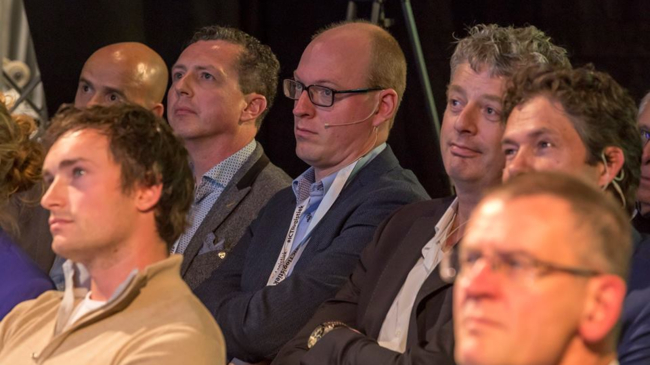
Image: The LMvhJ finalists during their first pitch at ICT & Logistiek in November.











