What does robotisation mean for warehouse employees? How are their tasks changing? And how can we make investments in robots more financially attractive? On Thursday 4 April, the Material Handling Forum will answer these and other questions. One piece of advice: consider the human factor and the financing issue already at the start of robotisation projects.
What skills will warehouse workers need if they will soon have to work together with robots? And will this make their work more or less attractive? These are some of the questions central to the research project 'Man and robot in the warehouse'. The leader of this project is TNO, supported by Erasmus University Rotterdam, Fontys University of Applied Sciences, Smart Robotics, Probotics, Robotacademie, KennisDC Logistiek and Stichting Logistica.
Approach to robotisation
Prof Michiel de Looze of TNO shares the first conclusions of the research project, which ends next year, at the seminar on 4 April. "We have developed an approach that helps companies take the human factor into account right from the start of a robotisation project. In the coming months, we will test that approach in companies. On 4 April, we hope to have the first test behind us."
De Looze and his team mainly look at employees' tasks. Which tasks will disappear if they have to work together with robots or AGVs? Which tasks will change and which tasks will be added? "Once we have that insight, we know what competences people need. Perhaps companies can develop those competences themselves, but at that point there is also a challenge for training institutes. Fontys University of Applied Sciences is going to investigate what the effect is on the curriculum of training courses," says De Looze.
Mental strain
Many robotisation projects pay insufficient attention to the human factor, De Looze argues. "This is a particular concern for warehouses that do not opt for full automation, but a combination of people and automation. Look at the goods-to-man systems we see more and more. People may not have to walk anymore, but they get in return a lot of monotonous repetitive tasks. How attractive is that work then?"
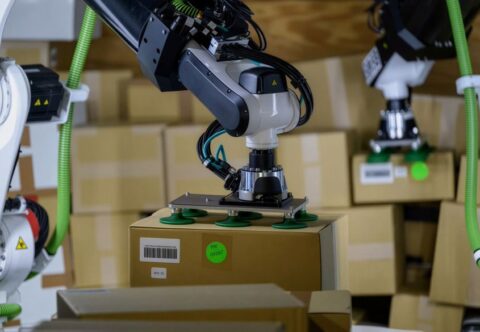
In warehouses where a palletising robot takes over the heavy lifting, work does become more attractive. "But if that means an employee now has to keep an eye on three robots, that in turn leads to greater mental strain. It is important to think about issues like that beforehand," De Looze argues.
Human capital
Especially now that good people are increasingly hard to come by, the human factor is becoming more important. Companies that think about this in advance may come to different choices. "Is it really wise to robotise as much as possible?", De Looze wonders aloud. "The residual tasks that remain are often not the most challenging tasks. This means that human capital is not being used optimally, when we so desperately need it."
De Looze is not the only one speaking about the large-scale research project. After him, ergonomics specialist Frank Krause of TNO, together with Agnes Berendsen, lecturer in mechatronics at Fontys University of Applied Sciences, will discuss in depth the impact of robotisation on the quality of work and on the skills and training of warehouse workers. Alexandros Pasparakis, PhD student at Erasmus University Rotterdam, shares his conclusions on a study on order picking supported by AGVs.
Leasing automation
Another question during the seminar is how companies can bear the large investments in automation. Many automation projects fail prematurely because investments are not recouped quickly enough. One possible solution is leasing. Michiel van Ramesdonk explains more. "With a leasing construction, the payback time reduces to zero," says the vice-president fleet solutions at leasing company DLL.
Leasing automation systems is possible, but requires customisation. Unlike a forklift, an AGV, robot or conveyor is less easy to redeploy after the lease ends. "We need much more information to make the best possible estimate of the economic lifetime. It is therefore important to engage the leasing company as early as possible, preferably already during the start of the design process. This sometimes results in other logistical choices," says Van Ramesdonk.
Location: Toyota Material Handling
The 'People and robots' seminar is an initiative of the Material Handling Forum. The event will take place on Thursday afternoon 4 April at Toyota Material Handling's premises in Ede. The meeting will conclude with a presentation by Wim Vos, director of advanced logistics at Toyota Material Handling, and an interactive forum discussion. For more information and to register, visit the website.