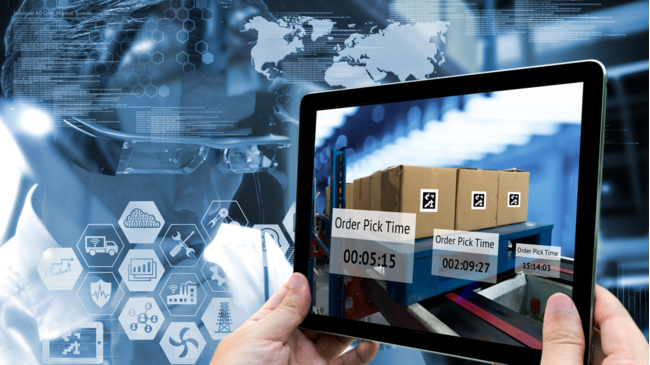
Customers are demanding more and more from our supply chains. At the same time, unpredictability and uncertainty in supply chains are increasing. This poses major challenges for companies. How can they ensure that their supply chains can continue to serve their customers optimally in the future? On 5, 6 and 7 November, Vakbeurs ICT & Logistiek will provide the answer: digitalisation with the use of tools in the field of Sales & Operations Planning, artificial intelligence and the Internet of Things.
Peanut butter with or without added sugar, with or without organic peanuts. Peanut butter with small peanut pieces, with large peanut pieces or without peanut pieces. Peanut butter with pieces of chocolate or caramel sea salt. Customers want more and more choice and they are getting it. Not just in the supermarket, but in the whole business. Anyone who wants to make a difference in today's market must offer their customers products and services that are fully adapted to their wishes and requirements. If not? Then the customer googles until he finds a company that does offer those products and services.
This has implications for the design of our supply chains. The time of 'one size fits all' is definitely over. Different customers require different approaches, especially also in the supply chain. Some want to receive their products exactly at the right time - not too early and certainly not too late - in the right order at the right location. The other has no preference for a time of day, but invariably chooses the cheapest option. We will have to segment our customer bases and differentiate our supply chains. And perhaps make hard choices. Because who can be the cheapest, fastest, most innovative and customer-friendly at the same time?
Sales & Operations Planning
More and more companies are adopting Sales & Operations Planning (S&OP). This approach gives them a better grip on market developments and more insight into supply chain opportunities to respond to them. Modern IT tools help companies gain insight into future demand per product/market combination based on input from sales. By providing people at all levels of the company with the same information, they are better able to match that demand with the capacity available in the supply chain. This enables informed decisions to be made: Which customer gets priority when capacity falls short? When should we build additional stocks or invest in additional production lines?
The question is whether companies' current S&OP approach is sufficient. Because exactly how reliable is demand forecasting? What are the opportunities to increase reliability by enriching information from sales with data - big data - from external sources? And what do all those figures say about the return on investment of certain products and customers? Companies making the move from S&OP to Integrated Business Planning no longer think in numbers but in euros. Which customers and products will we earn the most from? Then they fully commit to that.
Digitalisation of the supply chain
If the current times make one thing clear, it is that the world is no longer so predictable. The trade war between the United States and China is increasingly impacting the economy in Europe. The lingering uncertainty surrounding brexit and rising tensions in the Persian Gulf are also affecting companies in the Netherlands. If Trump imposes sanctions against Huawei, Dutch business partners of the Chinese telecom giant will also suffer. Who dares to state with certainty what their international supply chain will look like in one, two or three years' time?
The answer is digitalisation of the supply chain with the help of new technologies such as artificial intelligence and the internet-of-things. A fully digital supply chain - e.g. with the internet-of-things - creates visibility, a necessary condition for fast switching. With artificial intelligence, we are increasingly able to monitor supply chain processes and adjust them automatically. Smart IT tools help to develop multiple scenarios for the future, compare them and use them as a basis for decisions. One thing also applies in the future: good preparation is half the battle.
ICT & Logistics
ICT & Logistiek will take place on 5,6 and 7 November at the Jaarbeurs in Utrecht, simultaneously with Logistica trade fair. Within this theme, both partners and the content programme will show practical examples that will inspire visitors and offer them tools for their business operations. Visit the Logistica and ICT & Logistiek websites for more information or register here directly.











